Meditation gives rise to benefits and fruits for the person who meditates and for society as a whole. The benefits refer to the practical, pragmatic gains that flow from the practice while the fruits refer to the deeper inner flourishing that ultimately transforms the person who meditates. Although meditation has its origins in the wisdom traditions of the religions of the world, going back at least 3,500 years, many people first hear about the practice through the popularity of mindfulness, of which meditation is a key practice. Mindfulness acknowledges that in a very busy and frantic world we all need a break from external noise and stress. Sitting in stillness and silence makes us keenly aware of all the internal noise and reducing that helps to restore us to harmony. Meditation practice makes that possible.

The practical benefits of meditation are well proven through more than 40 years of research. Meditation helps to reduce blood pressure and improve the immune system. It lessens stress and improves decision making and problem-solving. It gives rise to better concentration and improves your capacity to pay attention. And it leads to an improved sense of well-being and greater emotional stability.
The practical, pragmatic benefits of meditation identified by such scientific research might be summarised under four key headings, as indicated in this slide. In other words, meditation benefits physical and mental health, enhances emotional intelligence and improves cognitive function.
Shanida Nataraja, in her book The Blissful Brain, suggests that the benefits that arise from meditation seem to be related to its capacity to promote whole-brain integration. The left and right-hand sides of the forebrain are separate and have quite different functions.
Generally speaking, the left hemisphere is associated with analytical, rational and logical processing; it divides, reduces, fragments, analyses and is the seat of language. By contrast, the right hemisphere is associated with abstract thought, non-verbal awareness, intuition and holistic thought, visual-spatial perception, and the expression and modulation of emotions.
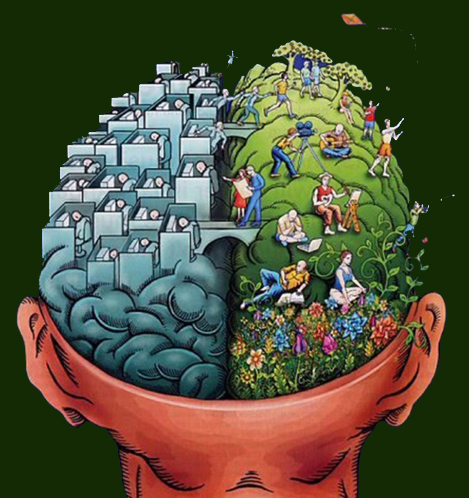
Western culture has overstressed left-brain activity and very many people in the West live out their daily lives in a way that is dominated by left-brain activity. Current neurological research suggests that the regular practice of meditation helps to open neural pathways, bridges between the two hemispheres, giving rise to a more integrated way of being in the moment, a more inclusive, cohesive mode of perceiving reality, which leads to a more balanced way of seeing and being in the world. In other words, meditation switches us from a way of seeing that is ego-centered to a more holistic viewpoint. And, as the ego is tamed, one gains a wider perspective and a renewed sense of inner freedom.
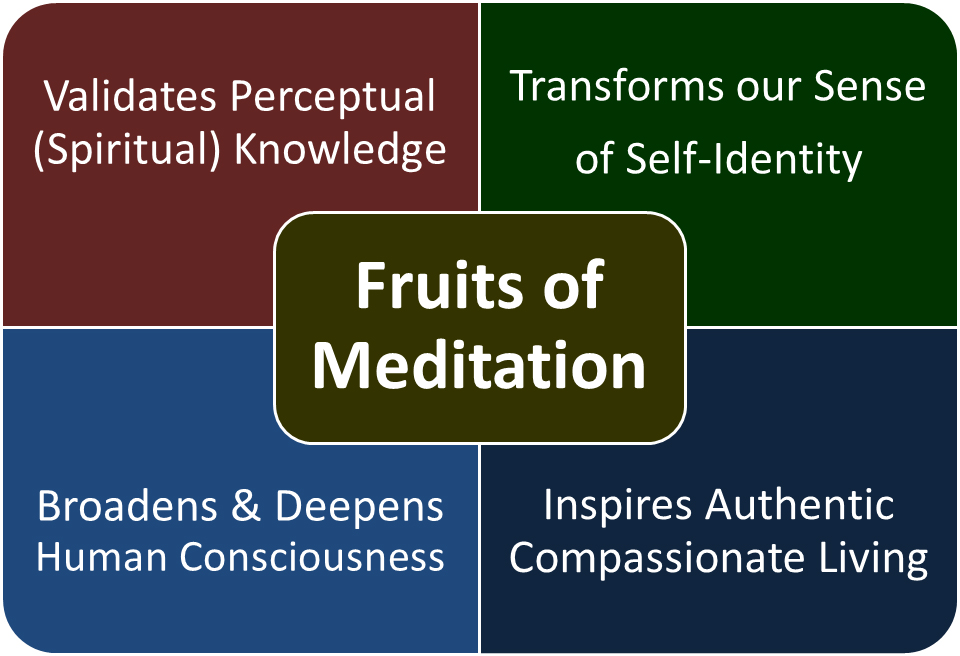
The wisdom traditions of the world proclaim that meditation also produces deeper fruits leading to greater self-awareness, individual and communal well-being and human flourishing.
The Christian tradition, while it acknowledges these fruits, holds that it’s real riches lie in the fact that meditation can lead to personal transformation at a very deep level because it awakens us to the value of perceptual knowledge. It teaches us that there is more than one way of knowing reality; that the Western bias toward rational thought, using the left-hemisphere of the brain predominantly, can blind us to the validity of experiential (spiritual) knowing that is associated with the right-hemisphere of the brain.
This, in turn, transfigures our sense of self-identity as we discover the true-self deep within and leads to real clarity of perception where we see reality as it is, without the filter of the ego. This changed way of seeing leads to a new way of being in the world. The Christian tradition teaches that one of the deep fruits of Christian contemplative practice is that it leads to a more authentic, more compassionate, Christ-centred way of being in the world.
Because meditation leads to clarity of perception it gives rise to greater accuracy of response. The parable of the Good Samaritan is a very good example of clarity of perception and purity of response. Why did the priest and the Levite not respond to the needs of the man who had been attacked and beaten and left for dead? I suggest that despite their religious training and religious office – perhaps because of them – they had other things on their minds that distorted their perception so they were not aroused to compassion. They were blinded by their conditioning, their preoccupations, their desires, their fears, even their religious training perhaps. They had urgent business elsewhere – possibly religious – that was, in their limited way of seeing, more vital than responding with love and compassion to the needs of another human being.
Although it is difficult to explain conceptually how it does so, meditation cleans the lens of perception so that we respond to whatever a situation calls for rather than react from our conditioning. The Christian tradition suggests that the fruits are a result of putting ‘the mind into the heart.’ John Main, who recovered the practice of Christian Meditation, described it by saying that meditation moves the centre of gravity from the head to the heart. In the stillness and silence of meditation we are freed to experience the now, to experience the underlying Presence that is the ground of all being. And that gives us a new way of seeing which ultimately becomes a new way of being in the world.
Together with WCCM, Christian Meditation Ireland has developed a leaflet exploring Meditation & Spirituality in a Secular Age. It suggests that spirituality is a vital, foundational element of what it means to be human, whether a person engages with that dynamism on religious or secular terms.
It argues that spiritual knowledge is not irrational but trans-rational; that spiritual knowledge is not merely a psychological insight but an experiential insight into one’s participation in Being itself.
Ultimately, meditation is the process in which we take time to allow ourselves to become aware of our infinite potential.