

Words are inadequate to describe our meditation experience because that experience is ineffable. It occurs at a level of consciousness deeper than our everyday self-consciousness and so it defies rational elucidation. Yet, when John Main or Laurence Freeman or other contemplative teachers speak about the experience of meditation, what they say can resonate deeply with us because we too have experienced it. So, while no combination of words can give adequate expression to it, they can point towards a truth we recognise because of that resonance. The words they use become stepping stones for us towards an inexpressible truth – to use a metaphor from the Rule of St Benedict, they disclose ‘the inexpressible delights of Love’ (Prologue 49).
Heidegger once wrote that poetry is language in service of the unsayable. I love that metaphor ‘in service of’ – poetry is language in service of the unsayable. It was Heidegger too who coined the word ‘inception’ to describe the process where our understanding takes a deeply insightful turn, where we suddenly grasp the truth of something at a very deep level, deeper somehow than the intellect.
Knowledge disclosed by such insight lies beyond the rational; it is knowledge of the heart – it is not irrational but trans-rational. John Main captured this understanding when he said that meditation moves the centre of gravity of our consciousness from the head to the heart. Just as meditation in our tradition is not a form of mental prayer but a prayer of the heart, the fruit of meditation is not rational knowledge but knowledge of the heart. As John Main expressed it ‘The “heart” is that focal point in our being where we can simply be in the Mystery without trying to explain or dissect it. A mystery analysed becomes merely another problem. It must be apprehended whole and entire.’
I’d like to explore with you how metaphor can help us to speak about contemplation in a way that can give rise to deep resonance within the listener who longs to deepen their own contemplative experience. All of us who meditate – in whatever tradition – are drawn to it because we experience an inner yearning for something deeper in our lives. We have developed an intuition that there is more to life than the desires of the ego. We often experience that yearning first as children. I recall at the age of ten or eleven reading a library book in which a character refers to a phrase from St Augustine – the saying that ‘You have made us for yourself and our hearts are restless until they rest in You.’ I remember how deeply that phrase resonated with my own heart when I first read it. And I think it is fair to say that that childhood yearning has ultimately guided my life.
James Finley uses a lovely metaphor that captures very well a malaise of our times. He says we spend much of our lives trapped on the outer circumference of the inner richness of our lives. I think that is a really rich metaphor which helps to capture how we get so easily caught up in the needs and desires of the ego and fail to pay attention to the inner richness of our lives. We are so busy doing, we don’t take time to simply be and we forget that the quality of our doing depends on the quality of our being.
As we strive to teach the richness of our meditation practice in a world that has become increasingly secular, I think the kind of metaphorical, non-religious language that Finley uses here is very helpful. I think that for many young people a phrase like that – how for so much of our lives we remain trapped on the outer circumference of the inner richness of our lives – can resonate more readily with their inner yearning than the theological language of any meditation tradition.
So while Finley reminds us that meditation brings us from the outer circumference of Doing to the inner richness of simply Being, John Main speaks of meditation moving our consciousness from the head to the heart. The words themselves don’t matter. They are metaphors, it is what they point towards that really matters. Metaphor, poetry and the arts can all point insightfully towards the inner richness that we hunger to experience and which leads to wholeness. Metaphor is a figure of speech where one thing is described as, and in terms of, another.
Metaphor can be a rich portal between self-consciousness and our deeper intuition. Poetic language takes us beyond the literal meaning of words and concepts into the metaphorical, evoking an awareness or experience of reality that goes beyond words. The poet Jane Hirshfield notes that while the unsayable remains unsaid, its meaning can be grasped and apprehended experientially albeit never exhausted. Metaphors succeed because the images they evoke resonate so strongly with the human heart.
I lead an online meditation group here in Ireland every Thursday and Sunday evening at 7:30 p.m. and each time I use a different contemporary poem as the reading. In what follows I’m going to look at a few poems to explore how they can give rise to rich contemplative insights and help deepen our appreciation of the mystery of our own spiritual experience.
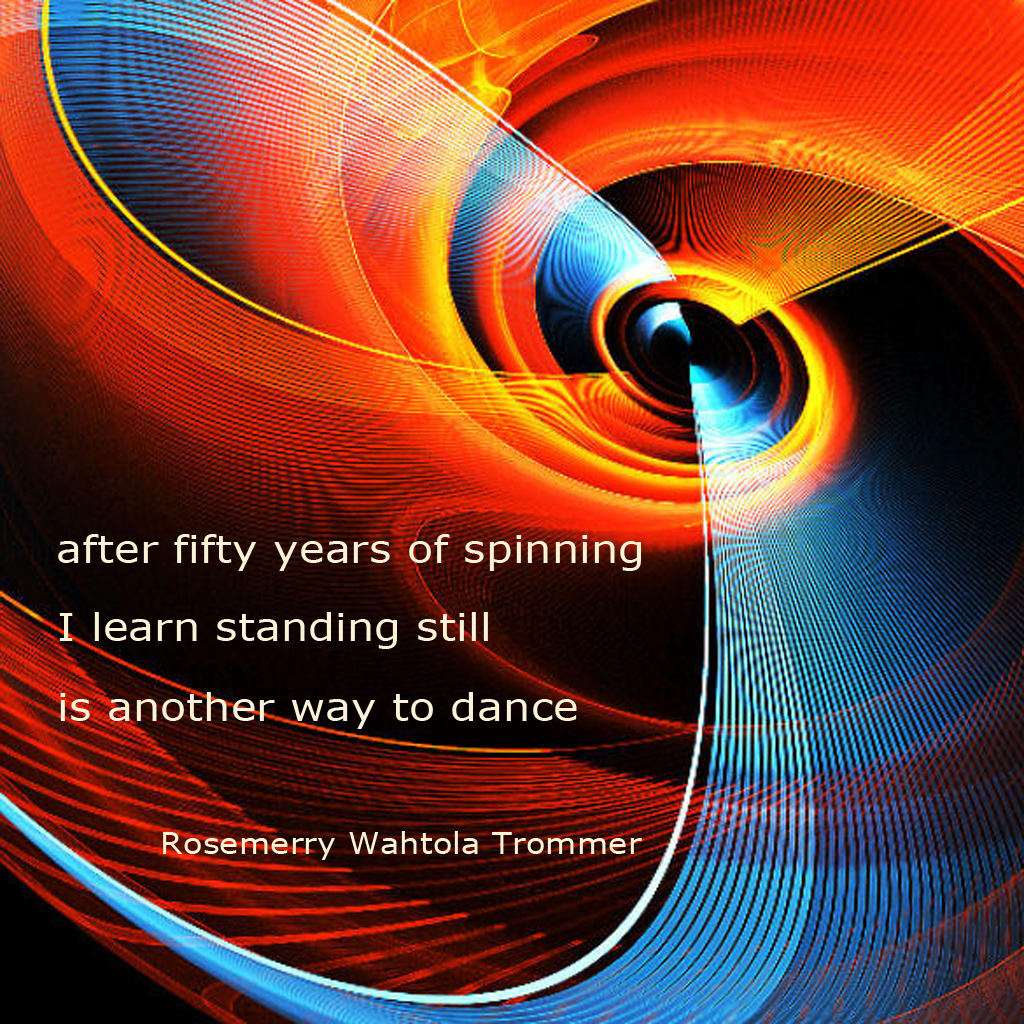
I’d like to begin with a very short poem by Rosemerry Wahtola Trommer who writes a poem every day on her blog. Contemplative poems can be very helpful in awakening the heart and very useful texts for Lectio Divina also.
Take a moment to read the poem on the right and ask yourself, what does this short poem arouse in you?
Is the central message of this poem not what we discover when we first begin to meditate? After fifty years of spinning – after spending so much of our time trapped on the outer circumference of the inner richness of our lives, after expending so much energy on doing – we learn standing still is another way to dance; a way of being as distinct from a way of doing.
We discover meditation as a journey into the mystery of our being, a pathway into the mystery of God. John Main repeatedly used metaphor in this way, as, for example, when he wrote that ‘by stillness of spirit we move in the ocean of God.’ [Monastery Without Walls: The Spiritual Letters of John Main (Letter 24, p221)]. He goes on to say: ‘Our meditation teaches us … that we have to put our whole heart into this work of the Spirit if we are genuinely to respond to the call to leave the shallows and enter into the deep, direct knowledge that marks a life lived in the mystery of God. John Main tells us that meditation enables us to pass beyond merely looking at the mystery of God as observers and to enter the mystery itself. We come to know God to the degree that we forget ourselves.
And, how do we enter this Presence? By saying our mantra. John Main builds on the metaphor of the oceans of God, adding that ‘Once we have left the shore of our own self we soon pick up the currents of reality that give us our direction and momentum. The more still and attentive we are [to our mantra], the more sensitively we [resonate with and] respond to these currents.’ This kind of metaphorical writing helps us to capture the transcendental nature of the experience without becoming lost in or confused by theological language and abstract concepts.
The poem by Trommer uses a different metaphor very succinctly to make the same point. She writes that we discover after fifty years of spinning that standing still is another way to dance. And note too the use of paradox – that standing still is a way to dance. Through metaphor and paradox we are able grasp immediately what we know to be true from our own experience. After so many years trapped on the outer circumference of our lives, busily doing, doing, doing – which she refers to as ‘spinning’ – we discover that standing still is another way to dance. That last phrase captures beautifully that the stillness of meditation is not static, but dynamic and receptive, that in meditation we cease to spin and allow ourselves to be danced. And once we discover this for ourselves, we feel drawn to create time for being still every morning and evening in the hope of ever so gently deepening our experience of mystery.
Let’s take a look at another poem, For Keeps by Joy Harjo. Joy is an internationally renowned poet and writer of the Muscogee (Creek) Nation in the United States where she served three terms as Poet Laureate of the United States from 2019-2022. The poem (0n the left, below) reads:
For Keeps
Sun makes the day new.
Tiny green plants emerge from earth.
Birds are singing the sky into place.
There is nowhere else I want to be but here.
I lean into the rhythm of your heart to see where it will take us.
We gallop into a warm, southern wind.
I link my legs to yours and we ride together,
Toward the ancient encampment of our relatives.
Where have you been? they ask.
And what has taken you so long?
That night after eating, singing, and dancing
We lay together under the stars.
We know ourselves to be part of mystery.
It is unspeakable.
It is everlasting.
It is for keeps.
from Conflict Resolution for Holy Beings by Joy Harjo. W. W. Norton & Company, Inc
Take a moment to ask yourself what line or phrase stays with you from this poem.
The setting of this poem sees the poet riding a horse to an ancient camping ground of her ancestors. Sun makes the day new … There is nowhere else I want to be but here. Isn’t that a fitting thought as we sit down to meditate. There is nowhere else I want to be but here. Of course, there will be days when this is not how we feel as we begin our meditation! Instead, we may feel the insistent, pressing urgency of our many preoccupations and needs. And, when that happens, it is so important to acknowledge them and then choose, gently to let them go and choose to simply be, still and silent, in the presence of all that IS. You can choose to lean into the rhythm of your heart to see where it will take you.
That line – lean into the rhythm of your heart to see where it will take us – reminds me of the beautiful poem by Hafiz called ‘The Seed Cracked Open’. In it he speaks of how he used to ask himself first thing every morning ‘What am ‘I’ going to do today?’ But when the seed of his understanding cracked open and he knew who he was in God and God in him, he would ask instead ‘God, what love-mischief can we do for the world today?’
Meditation teaches us the same truth, so that our seed is cracked open and with certainty of heart we know ourselves to be part of mystery too. The mystery that is unspeakable, everlasting and for keeps and which calls us to join in the dance, to allow ourselves to be danced. So the next time you sit down to meditate say silently in your mind: there is nowhere else I want to be but here.
Let’s look at one last poem, ‘Not A One’ by Mark Nepo which is reproduced on the right. Take a moment to read the poem and ask yourself how it resonates with you. Is there a line or a phrase that stays with you or what resonance does the poem as a whole evoke in you?
The poem begins with the line: ‘A funny thing happened on my way to being awake. I outgrew all my masks.’ Those who meditate will recognise this is one of the key fruits of meditation – it makes us aware of the masks that we wear every day and we learn to outgrow them. As we sit in silence, still in body and not quite so still in mind our preoccupations are revealed to us in every thought and feeling that assails us in the silence. And, mysteriously, our very awareness of their existence can be enough to break their claim on us. They will still appear but we are no longer imprisoned by them – we can see them for what they are and they lose their hold on us.
As John Main wrote in his final letter: Our life is a unity because it is centred in the mystery of God. But to know its unity we have to see beyond ourselves and with a perspective greater than we generally see with, when self-interest is our dominant concern.
The more objectively we can see the desires and preoccupations of the ego, the less their grasp and we discover how to respond to life’s circumstances rather than merely react out of our conditioning and emotions. Once a mask is recognised and acknowledged, we are able choose not to hide behind it but to be true to our deepest sense of who we are.
‘Not A One’ by Mark Nepo
A funny thing happened on my way
to being awake. I outgrew all my masks.
Not a one fit. Not the one I called my
past. Not the one I called my dream.
Not the one I wore when sad. Or the
one I wore when trying to be happy.
I saved them all like favourite shirts
I thought would fit when I became
myself again. But that was a mask, too.
Then, just the other day, I was more
present than lost, and had to put down
the mask I called my story.
And today, a gust of light filled my face.
I felt it on my skin and in my soul.
Now, anything is possible.
At first, the poet says when he had developed the capacity to put his masks aside, he still saved them for a rainy day! Who knows when they might come in handy! But soon he learned the act of saving them was merely another mask. Our daily practice of meditation changes our sense of self-identity and we learn, as the poet describes it, to put down the mask we call our story. And then it’s as if a gust of light fills our face. We feel it on our skin and in our soul and realise that, now, anything is possible. As meditation awakens the heart, our masks dissolve and we discover our true-self. This realisation dawns when we are more present than lost, attentive to the inner richness of our lives.
For each of the poems we have looked at there are thousands more that are equally contemplative and which can evoke a very deep sense of Presence. Heidegger once said that the vocation of the poet was to evoke the holy; to evoke our capacity for wholeness. I hope I have shown that contemplative poetry can be a real portal to the Real Presence because while the experience of meditation is the real teacher, poetic language and metaphor have great capacity to give voice to that experience and its potential for personal transformation.
Our desire as meditators is to never forget that we are at all times immersed in the oceans of God; allowing ourselves to be drenched by the silent, gentle undercurrent that is Divine grace. By allowing ourselves to be steeped in Love, doused and saturated by Divine Love, we hope to become ever more authentic expressions of Love in our daily lives, in all of our encounters, in all of our relationships. But the reality is that so often as we return to the busyness of our daily lives, we lose that sense of deep connection with Being. Yet, as Rosemerry Wahtola Trommer writes in another of her poems, recalling a walk in a scent-filled garden, ‘Hours later the scent is long gone, but I can’t unknow how sweet it is.’
So it is with our daily practice. Meditation validates knowledge of the heart and draws of sense of self-identity towards its true centre – and our daily practice reminds us that we can never unknow how sweet that is.
Let me leave you with one final metaphor from Alex, a twelve-year-old Canadian girl, who once told her teacher ‘When I hear the chimes at the start of meditation, I imagine it is God ringing my doorbell and I open my heart to let Him in.’ What a rich metaphor for a young child, based on her own personal contemplative experience. May that metaphor arise in you as you next sit to meditate. And as we grow in and from our daily practice, may we ‘run on the path of God’s commandments, our hearts overflowing with the inexpressible delight of Love.’
Noel Keating, 30 August 2023

