

The Annual Forum and AGM of Christian Meditation Ireland, which had been scheduled for Saturday, 05 April 2025 has been postponed. An alternative date will be advised in due course.
There is no further news about the proposal to host the John Main seminar in Dublin in November 2025.
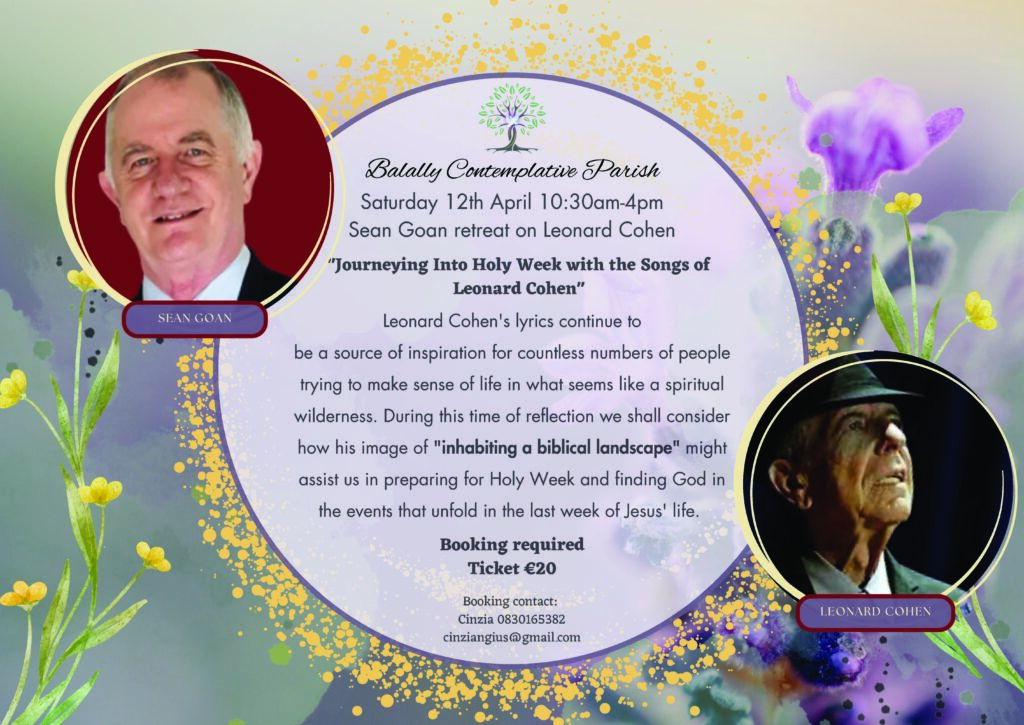
Meanwhile, Balally Parish extends an invitation to one and all to a contemplative retreat with Sean Goan informed by the songs of Leonard Cohen. It promises to be a n excellent preparation for Holy Week and Easter.
Booking is required – contact Cinzia Angius through her email cinziangius@gmail.com or by phone on 083 0165382.
We had a wonderful Meditation Meet-Up in Balally on Saturday, 01 March 2025. Michael Lane, a long-time practitioner of Christian Meditation, gave an excellent talk on meditation informed by the teachings of John Main and the work of Fr Pat Murray who spent many years promoting the practice across Ireland. At the outset Michael spoke of the inability of language to adequately express the essence of meditation and its fruits. There is no way, for example, that words can capture the scent of a hyacinth – we have to experience it to know what it is like. We need to remember too the observation of Heraclitus that whatever is spoken always contains something untrue! There is a danger in our times that language is losing its meaning so that the essence of such valuable concepts as Faith, Hope and Charity losing their meaning too.
And, yet, as noted in the title of Donagh O’Shea’s recent book there are ‘A Hundred Roads to Here’! Like Donagh, Fr Pat Murray was one of the best communicators of the contemplative tradition. His essential conviction was that total goodness resides in every human heart – we are good simply because we are and we must know with utter clarity that God has been poured into our hearts. But to realise this fully we must first open our hearts and realise, as it says in Thessalonians 1:5, that the ‘gospel came to you not simply with words but also with power, with the Holy Spirit and deep conviction.’ As John Main reminds us ‘meditation verifies the truths of your faith in your own experience’. Our practice teaches us that Jesus’ prayer in John 17:21 ‘ that all of them may be one, as You, Father, are in Me, and I am in You – may they also be in Us’ has been answered and that God dwells in us and we in God. When we give our thinking mind a break and get out of the way – as we do in meditation – our heart awakens to this deep truth of who we are in God and who God is in us. We are addicted to thinking – it is seen in modern society as a respectable addiction – and we need to break that habit.
John Main considered that ‘Lent, no less than Christmas or Easter, is full of the risen life’ and he considered that ‘the hardest parts of our life experience often point us into freedom. Lent can allow us ‘to enter once again and more deeply into the great awakening of Jesus, his Resurrection.’ Michael reminded us that during lent we experience ourselves as forgiven and we come to realise. as John Main wrote. that ‘Jesus has transcended the limitations of human experience that we confront in ourselves during Lent – he has led man (sic) into the infinite circle of God whose centre is everywhere and whose circumference is nowhere.’ Like Lent, meditation is not about failure or success but perseverance. While initially we experience distractions as extremely frustrating, we come to realise that every distraction leads us back to listening to our word as we sound it silently. When we persevere with our practice we discover true freedom – our practice gives us faith in our true self, not our imagined self, or our idealised self or our failing self , but it grounds us in our true-self.
Fr Pat Murray used to encourage his retreatants to go out into nature and to spend time there alone – without ‘the narcotic of a companion’, without the narcotic of the thinking mind because unless we are prepared to transcend thinking, meditation will be inexplicable. It is only by letting go of thought that we can hope to have the same mindset as Jesus as we are encouraged to become in St Paul’s second letter to the Philippians: ‘In your relationships with one another, have the same mindset as Christ Jesus: Who, being in very nature God, did not consider equality with God something to be used to his own advantage; rather, he made himself nothing by taking the very nature[b] of a servant, being made in human likeness. And being found in appearance as a man, he humbled himself by becoming obedient to death – even death on a cross!’ We are called to empty ourselves as Jesus emptied himself . We are called to undergo. a conversion of heart and strive to take on the consciousness of Christ.
Letting go of thought leads us to true silence, which St John of the Cross reminds us, is the truest response to mystery because ‘Silence is God’s first language’. Silence leads us to knowledge of the heart, to an acknowledgement of who we truly are; to appreciate that, like the universe, we too are ultimately an expanding infinity and our daily practice helps us to receive and accept this expansion of our being. We discover the Spirit dwelling within us and know, as the Book of Wisdom says ‘ that nothing impure can find its way in ‘ to our true-self. John Main tells us that by opening the eye of the heart, meditation leads us away from self-consciousness into ‘a deeper and more simple consciousness that allows us to know that we can love and be loved and that we are all in love.’ It allows us to become one with ourselves, to an integration of mind, body and spirit.
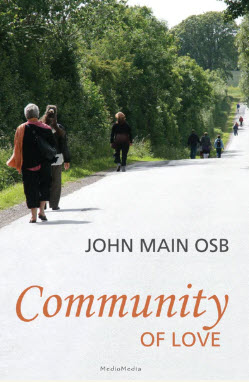
Michael reminded us that John Main’s last public talk was to two thousand delegates at an international seminar on Terminal Care, at a time when he knew he himself was in terminal decline. Laurence Freeman observes that ‘Composed in the knowledge of his own terminal illness the talk is a unique presentation on the meaning of meditation.’ Entitled ‘Death – the inner Journey’, the talk is published in the book ‘Community of Love. In it, John Main reminds us that in meditation we access our true-centre where ‘ The Kingdom of Heaven is within’ us. If we are ‘to face death with a hope that makes us fully human and to live with a spirit of liberty and joy in being we must find this centre in time.’ The search for this centre ‘is not in the first place an elaboration of concepts. It is not in the first place an intellectual penetration of the mystery. In the first place the search is conducted simply by allowing ourselves to be.’
Main also reminds us that ‘The inner journey is a way of union. Firstly, it unites us to ourselves. Then (as our personal fulfilment is found beyond ourselves) it unites us to others. And then (as union with others opens up the heart of the mystery of love to us) it unites us with God, so that God may be all in all.’ While ‘this inner journey is a death to egoism it is to the same degree a birth into life.’
Meditation is both ‘a way of dying and a way of living. While you are saying the mantra you are dying to what is the most difficult thing in the world for us to die to. We die to our own egoism, to our own self-centredness as we go beyond our self-consciousness. And the reason is simply that while you are saying the mantra you are not thinking about yourself. You are attending to the mantra. And as through a lifetime you learn to say the mantra with deeper and deeper abandonment, with stronger and stronger faith, you die to everything that restrains you from the fullness of life. It is this fullness of life that is our destiny.’ Ultimately, ‘ Meditation is a healing process. What is healed is the essential wound we all have: the wound of the divided self that separates us from ourselves, from others, from God – and so from our own full potential.’
John Main draws three practical conclusions at the end of that talk: ‘Firstly, we must all prepare for death. Just as we prepare for life by our education so must we prepare for death. – Secondly, to live fully we must live in relationship with others. We must live our lives with love. To learn to love we must learn to die to self. – Thirdly, meditation is the perennial wisdom that appears in all ages and all traditions leading us away from egoism and its limitations, into love. – And finally, meditation is, therefore, well-called in the tradition the first death. It is the essential preparation for the second death which is our definitive entry into eternal life.’ Michael’s talk was followed by a question and response session during which he shared his wisdom and a range of engaging anecdotes about his personal experiences of meeting John Main and Pat Murray.
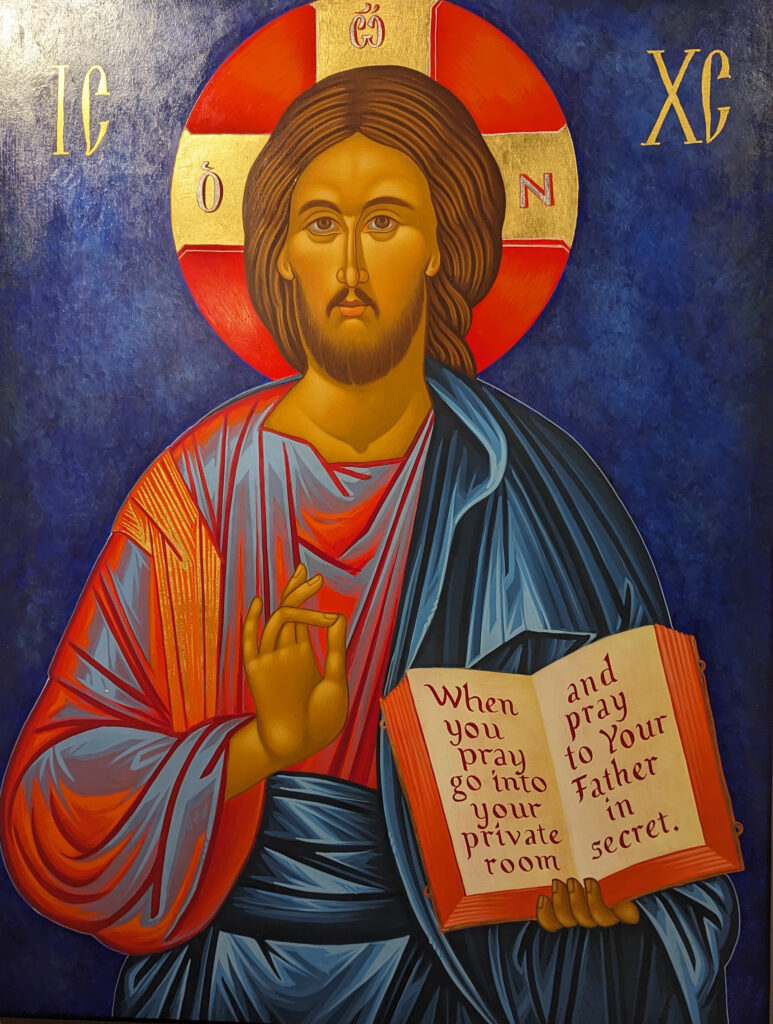
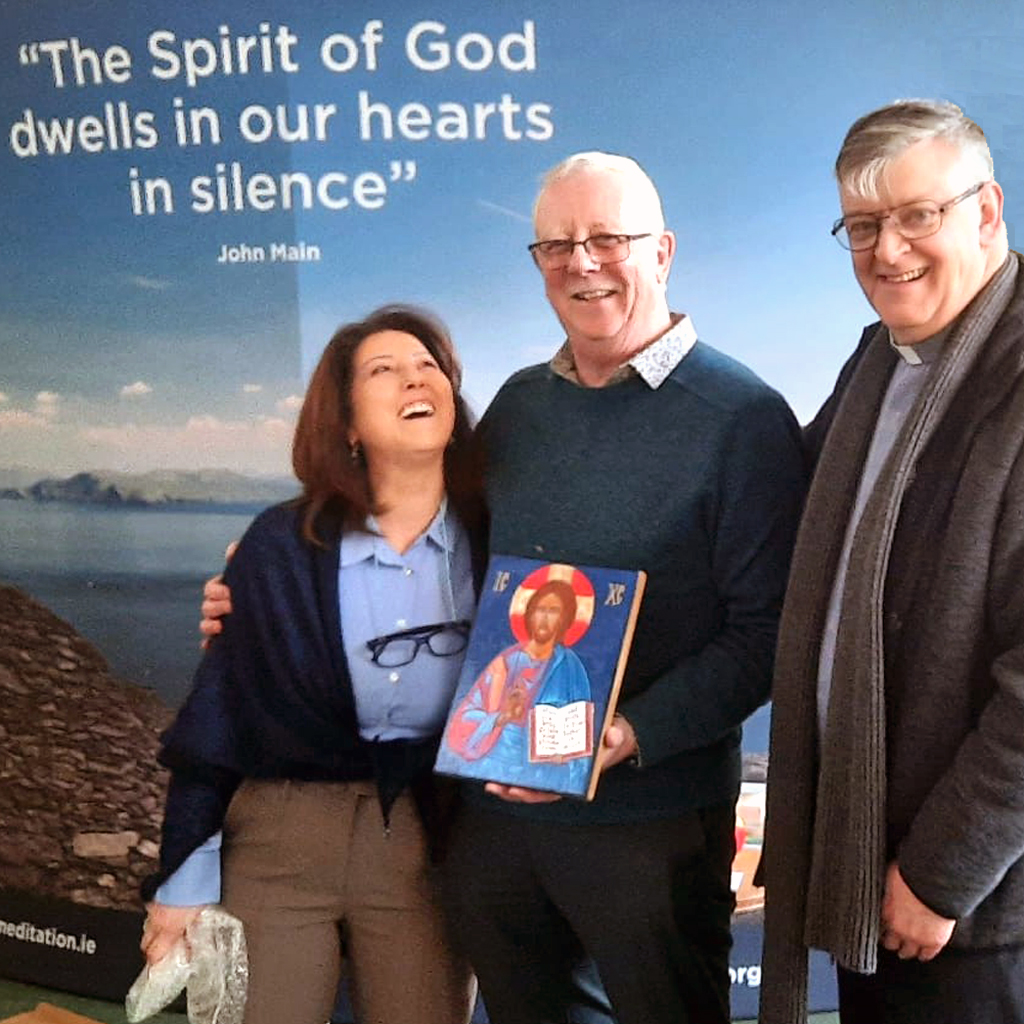
After the meeting, Noel Keating who resigned in January after nine years as National Coordinator, was presented with a beautiful icon which replicates one in the Icon chapel at Balally. In the photo are Fr Jim Caffrey, the Interim National Coordinator and Cinzia Angius who authored the icon.
Poem in Which I Inspect The Fabric Care Label
by Dick Westheimer
I never noticed the tag sewn discretely
behind my knee. I guess my mother
was afraid to clip it off. Maybe she thought
“Do Not Remove Under Penalty of Law”
was meant for her. My wife noted it
before I did. What’s this she said as she
thumbed at it absently. She held a mirror
for me to read the fine print: “Made of flesh
and insecurities. Wash gently. Hand dry.
Prone to wonder if he is loved no matter
how tenderly treated.” She nuzzled her cheek
on my chest, stroked loose skin on my neck
and then turned over and headed toward sleep.
The label fluttered against my calf and I
understood why it was not wise to detach it.
How else was I to understand why,
even with her caress still humming
and forty years of knowing the answer is yes,
I fret over what she’ll think of me pulling
her close and folding the soft fabric of her
into the care label of me.
Reflection by Noel Keating: This poem was written in response to a prompt to write an ‘In Which’ poem after the style of Denise Duhamel – the Rattle Foundation had published a collection of poems by Duhamel, each of whose titles contained the phrase ‘in which’ e.g. ‘Self Portrait in Which I Am Not Polite’! Each poem employs a kind of amused outrage, deconstructing the grand narratives people unconsciously accept and live by. Writing about Westheimer’s poem, our poem for this session, the series editor observed that ‘ What starts as a humorous title inspired by Denise Duhamel soon plunges us straight into the suds. There is more truth in this poem than there are greeting cards sold on Valentine’s Day. Such a big part of relationships is learning each other’s care labels. Much like the itchy tags on shirts I have been known to cut off, a lack of intention can result in dismissing everyone’s needs. A freshly-laundered poem of tender, mature love that will stay on our line for many years to come.’
One of the very practical things that meditation achieves for us is to make us aware of our conditioning. As we sit in silence, our preoccupations arise to the surface – they arrive like waves on the shore of our consciousness and it takes time for us to realise that we do not have to engage with them, no matter how persistent they are. While sometimes they relate to something urgent we have forgotten to do, very often they arise as niggles – thinks that rankle us, often because we feel unloved, unappreciated or misunderstood. And we may often find that on mature reflection they arise because we have been conditioned by life’s circumstances to expect things to be done in a certain way, as if there was only one right way of doing anything!
Isn’t the notion of having an instruction label attached behind the knee a very clever way of thinking about acknowledging our conditioning – accepting that our way of seeing and being in the world is a product of our upbringing and our culture and can in fact be reframed: Made of flesh and insecurities. Wash gently. Hand dry. Prone to wonder if he is loved no matter how tenderly treated. What would your label say about you? How more open and honest would your relationships be if you could read your own label, accept it and over time reframe it?
The good news is that this is one of the many things meditation accomplishes in us when we remain faithful to the practice over many years. As we discover who we truly are at the centre of our being, we find we are no longer imprisoned by our conditioning, and we are able to release ourselves ever so gently from the defence mechanisms of the ego. We become kinder persons.

