

After nine years at the helm of Christian Meditation Ireland, Noel Keating has stepped down from the role of National Coordinator. Appointed in May 2016, Noel has served faithfully in that role, supported by an active and committed Board.
Noel has been a member of the Irish Meditation community for many years having started a meditation group in Carlow in 2011 which continues today, meeting every week in the Cathedral Parish Centre in Carlow. He joined to National Committee as he launched the Meditation with Children Project in November 2012. Since then, over 280 primary schools have introduced the practice of whole-school meditation benefitting over 56,000 children. Noel’s unique doctoral research on children’s experience of meditation and its fruits has informed that work.
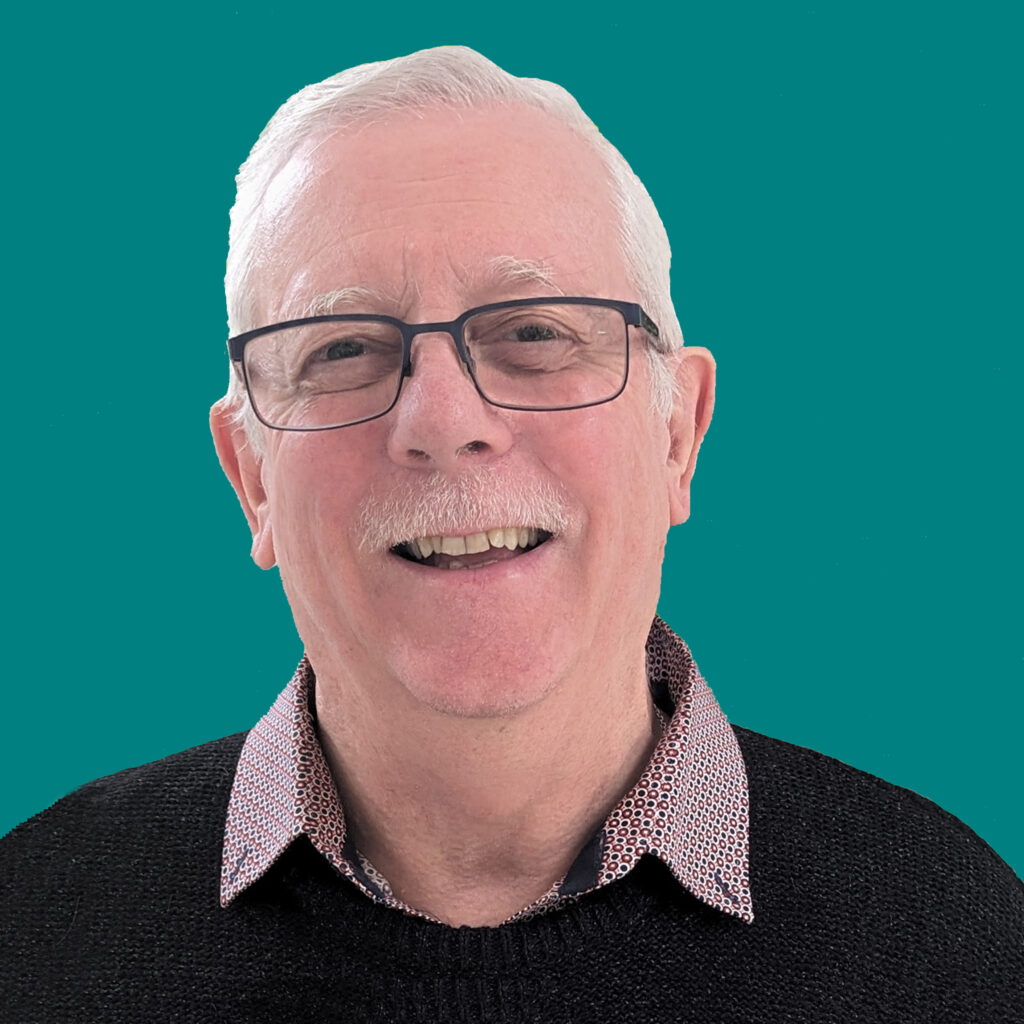
Christian Meditation Ireland became a legal entity in 2013 and Noel joined the Board as Company Secretary, a role currently held by Joe Brophy. Noel was appointed as National Coordinator by WCCM Director, Fr Laurence Freeman in 2016 and has sought for the past nine years to animate the Board and the Irish meditation community. Noel coined the acronym ‘OIL’ to represent the three core tasks of the Board viz. out-reach, in-reach and leadership, seeing the work of the Board as the oil that keeps the life of the community flowing smoothly. Out-reach relates to initiatives that promote meditation in modern society, of which the Meditation with Children initiative is an example. WCCM encourages communities to reach out in this way promoting meditation in prisons, in business, with the homeless and so on and the Board is always seeking to engage with people in such fields to develop further initiatives. Noel organised an event commemorating John Main in Trinity College, Dublin in September 2017 and lead the team that participated in the World Meeting of Families in the RDS in 2018 where he engaged with teenagers from across the world, promoting meditation as a form of silent, imageless prayer.
In-reach relates to the services that support those who meditate and who have formed or wish to join a local meditation group. In terms of in-reach Noel instituted regular Dublin Meet-Ups following the example of the Cork region and has encouraged other regions to follow suit. In addition, our annual retreat builds community as does the annual forum and AGM. In recent years, Noel redeveloped the Christian Meditation Ireland website and Newsletter with a view to improving how the Board engaged with and supported meditators across Ireland. The revised website gives easy access to a wide range of resources that support individual meditators and weekly groups, including specific resources for those who would like to form a group in their own area.
During Covid, when it was impossible for local weekly meetings of meditators to continue, Noel established twice-weekly online meditation sessions which continue today every Thursday and Sunday evening at 7:30 pm. Following the break imposed by Covid, the Board has encouraged the reformation of local weekly meetings of meditators. Those groups that have re-formed are listed on the ‘Find a Group’ page of our website.
While he has resigned as National Coordinator and as a member of the Board, Noel will continue to support the work of our community from the sidelines. He will continue facilitate the online meditations on Thursdays and Sundays and will continue to lead the Meditation with Children project for as long as the Board wishes and circumstances allow. Noel is also working on a draft module on meditation for second-level schools.
Our Annual Forum and AGM will take place on Saturday, 05 April 2024 in Balally (D16 E032) from 11 a.m. to 1:30 p.m. Tea and coffee will be available from 10:30 onwards, so come a little early!
This is our annual opportunity for those interested in meditation across Ireland to get together, to explore how we can spread the good news about the benefits and fruits of meditation and engage with others in our community. Your attendance will help make this a lively and rewarding event where we can continue to animate and renew our community. We hope that representatives from all of our regions will attend in person.
Participants will make their own arrangements for lunch after the meeting. If you wish, bring a packed lunch and tea and coffee will be provided.
Our first Meet-Up in 2025 will take place on Saturday 01 March 2025 in Balally Parish Centre, D16 E032. This is a great opportunity for all meditators – and those interested in hearing about the practice – within travelling distance to meet with fellow meditators for contemplative nourishment and a chat.
Michael Lane, who has a deep commitment to the practice and promotion of contemplation , will be our speaker. His talk will be followed by a 20 minute meditation after which there will be an opportunity for dialogue.
Tea and coffee will be available from 10 a.m. and the meeting will start at 10:30 a.m. and conclude by 12:30 p.m. See you there! Click here for directions to Balally.
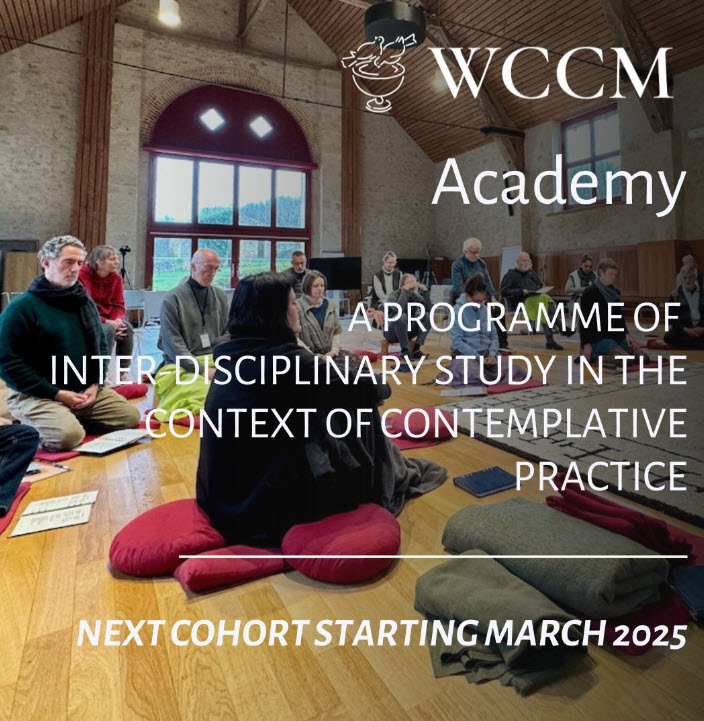
The Academy is a 2-year programme of interdisciplinary study in the context of contemplative practice. Run by WCCM, it is facilitated by an international team of experts who are themselves contemplative practitioners. Each academic year comprises three 8 -week terms with breaks in between. All students are encouraged to attend 3 in-person week-long events over the course of the two-years. These are held in Bonnevaux France, the spiritual home of WCCM worldwide and in other venues. All dates are available before the course commences. Two persons from Ireland, Noirín and Patricia, will become graduates of the inaugural programme in March of this year. In this article, they describe their experience of the programme:
The Academy programme is a most rewarding and enjoyable experience and a magnificent opportunity to explore contemplative wisdom teachings both in Christian and other wisdom traditions and to learn how this wisdom can be practiced and developed in practical ways in daily life. Expert teachers from many disciplines including the worlds of science, technology, philosophy, environment, theology and politics introduce many new ideas and ways of thinking about the world we live in today.
The variety of themes and topics explored is both inspiring and revelatory and has opened up so many areas that can be studied in greater depth by participants in their own time in the years ahead. The interactive presentations provide opportunities for discussion and sharing of diverse views of both students and teachers for the group as a whole and in smaller groups where lively debates and sharing of ideas is both fun and educational. Texts assigned in advance for reading ensure students have some knowledge of the topics for discussion and exploration prior to class, which makes for an enjoyable and meaningful learning environment. On a practical level the facility of being able to watch recordings of classes and lectures that might have been missed due to life commitments is very welcome and also provides the opportunity to listen again to talks that are of particular interest to students.
The diversity in backgrounds, cultures and life experiences of the course participants was both extraordinary and remarkable. Students from different Christian and other traditions and those from no particular tradition regularly engaged in lively and informative discussions both online and in other forums. The integration of personal experience with an academic perspective was enriching and transformative and the resulting community is very likely continue long after the course concludes.
The motivation for embarking on the Academy journey was to deepen our understanding of the contemplative dimension of Christianity and to support and develop a contemplative approach to daily living through an integration of learning and the practice of meditation. The course delivers on all levels and has inspired the desire for further discovery and learning in many of the areas explored.
We would encourage anybody with an interest in understanding how contemplation and meditation can be integrated in all areas of life and who would like to deepen and support the practice of meditation to embark on the Academy course – it will not disappoint!
The study commitment is 7-9 hours /week on average including two x two hour zoom sessions on Tuesdays and Thursdays during the three 8-week terms.
The next two year cycle will launch in Spring 2025, concluding in Spring 2027. For further information click on the image above or contact lucie@wccm.org
Let Evening Come by Jane Kenyon
Let the light of late afternoon
shine through chinks in the barn, moving
up the bales as the sun moves down.
Let the cricket take up chafing
as a woman takes up her needles
and her yarn. Let evening come.
Let dew collect on the hoe abandoned
in long grass. Let the stars appear
and the moon disclose her silver horn.
Let the fox go back to its sandy den.
Let the wind die down. Let the shed
go black inside. Let evening come.
To the bottle in the ditch, to the scoop
in the oats, to air in the lung
let evening come.
Let it come, as it will, and don’t
be afraid. God does not leave us
comfortless, so let evening come.
from The Best Poems of Jane Kenyon
Reflection by Noel Keating: Jane Kenyon once described writing this poem as ‘a mystical experience’ which ‘seemed to come from some very secret place, some place I hardly know myself – or else from somewhere else. It came through me.’ On another occasion she observed that ‘For me, poetry comes out of silence’ adding ‘I need to work on some frontier where I don’t know myself what’s going to happen next’.
The simplicity of this poem, and the absence of a defined narrator, create a universal experience, drawing the reader to identify with the beauty depicted in each scene. One of the features of Kenyon’s poetry is this kind of repetition combined with attention to details which are perfectly noticed and recorded. The precise images and sounds of a rural evening are the result of profound attention and we are drawn to give each scene the fullness of our attention. Each of the first five stanzas paints a simple yet beautiful picture of rural life: Let the light of late afternoon shine through chinks in the barn, moving up the bales as the sun moves down. One can picture the scene while we stand in awe at the rays of light falling through chinks in the timber wall of the barn, causing chinks of light to rise up the bales of hay as the sun descends.
And each of the six stanzas begins with the word ‘Let’. We are invited to observe what is and to let it be without interference, to pay attention and be astonished by what we see and allow what is to simply be: let the light shine, let the cricket chafe, let the dew collect, let the woman take up her needles, let the stars appear and the shed go black inside and repeatedly, let the evening come. That recurring theme, ‘Let evening come’ expresses trust in God’s care for each of his children. The poem is both a meditation on the beauty and comfort of nature and an expression of faith.
In a 1989 interview Kenyon told Bill Moyers: “It’s funny how everything in your life, every experience, everything in your reading, everything in your thinking, in your spiritual life—you bring it all to your work when you sit down to write.” This poem is a good example of how the simple experiences of life can become a starting place for exploring the deep mystery of life.’
The coming of evening symbolises not just the darkness at the end of the day but also the challenges or difficulties that we may encounter in our life. Kenyon seems to be saying that there is no need to be afraid of the darker moments we experience in life because truly there is something profound and meaningful beyond that. The poem expresses faith that while we will not be protected from them, God will always be there to sustain us through our difficulties. Let Evening Come is a reverential, psalm-like poem which calls us to pay attention and to perceive and accept Reality as it is: Let it come, as it will, and don’t be afraid. We are called to give up all resistance to what we can’t control and live in right relationship with God who does not leave us comfortless. It reminds me of the simple faith inherent in that lovely children’s prayer: ‘Now as I lay me down to sleep, I pray the Lord my soul to keep. Please, guard me Jesus through the night, And keep me safe till morning’s light.’
Our commitment to our twice-daily practice of meditation is another example of that faith-filled understanding that God dwells within every person and that God does not leave us comfortless, so let evening come. Perhaps we might add to our closing prayer after our evening meditation each evening that simple but profound phrase ‘Let evening come’.

