

National Coordinator Ireland
During 2025, Fr Jim Caffrey assumed the the role of interim National Co Ordinator, succeeding Dr. Noel Keating. After consultation with Fr Laurence, it has been agreed that Cinzia Angius, Thérèse Conroy, Barry White and Fr Jim will serve as a Team of National Co-Ordinators, with one taking the lead role for a year, starting with Fr. Jim In 2026.

National Centre - Christian Meditation
Following consultation with Fr Laurence, Balally parish has now been designated as the Centre for Christian Meditation Ireland (WCCM Ireland). We encourage all meditators to join in the range of in-person events in Balally, including Morning and Evening Prayer from the Icon Chapel. See the Balally Parish website for times of prayer.
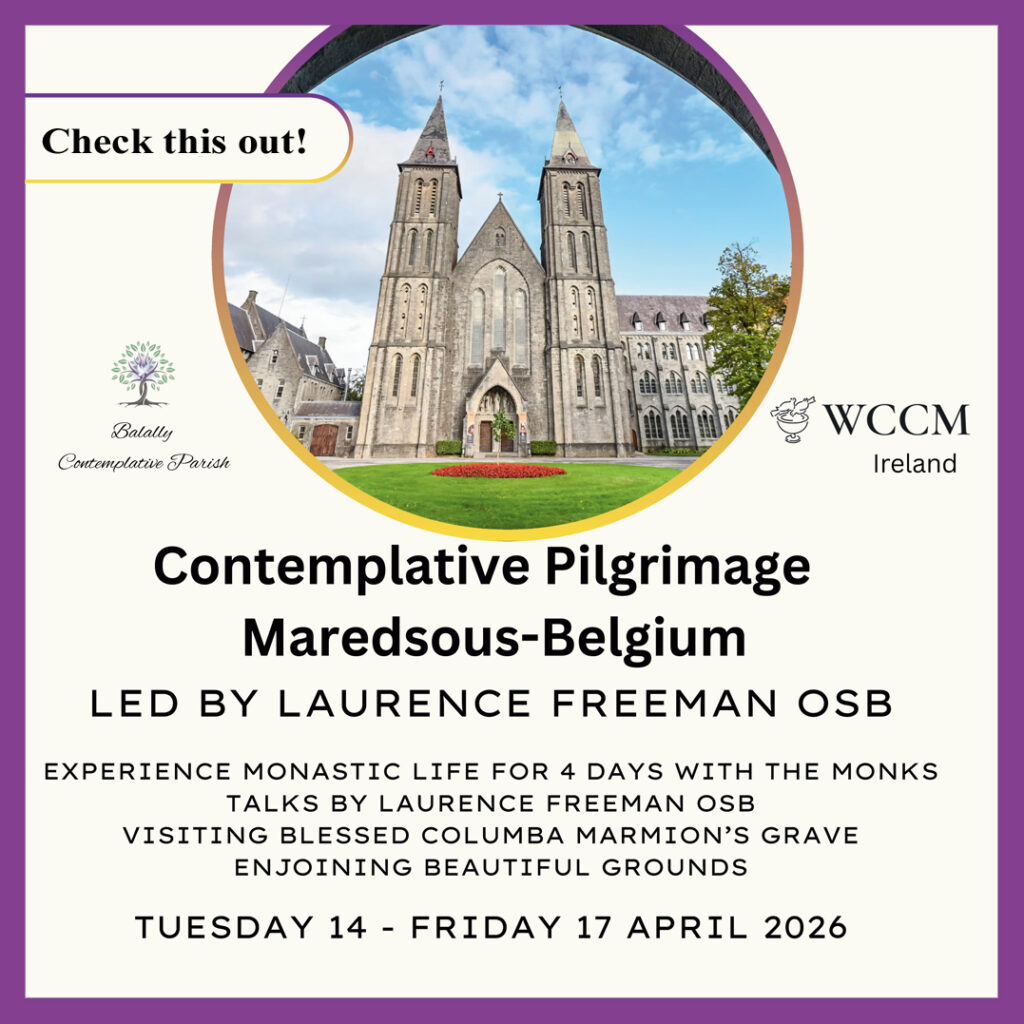
Balally Parish and Christian Meditation Ireland are organising a pilgrimage to the beautiful Abbey of Maredsous in Belgium. The pilgrimage is in honour of Blessed Columba Marmion, an Irish Benedictine monk who was the third Abbot of Maredsous Abbey.
Columba was born in Dublin, on 1 April 1858, into a large and very religious family. His father was from Clane, Co. Kildare and his mother was French. From a very early age he was seemingly “consumed with some kind of inner fire or enthusiasm for the things of God“. He received his secondary education at Belvedere College in Dublin. At the age of 16, Marmion entered the diocesan seminary at Holy Cross College in Clonliffe. He considered “that a man’s love for God is measured by his love for his neighbour“. Ordained in June 1881, he was appointed curate at the parish in Dundrum in the south of Dublin. In September 1882, he was appointed Professor of Metaphysics at Holy Cross College at Clonliffe.
He felt called to the monastic life and joined the monastic community at Maredsous in November 1886 and he he helped to found the Abbey of Mont César, Louvain, Belgium in 1889 and became its first prior – a position which he held until he left Mont César in 1909 to become abbot of Maredsous, a position he held for 14 years. He died in 1923 and is buried at Maredsous. Dom Columba Marmion was beatified on 3 September 2000 by Pope John Paul II.
The pilgrimage to Maredsous will take place from Tuesday 14 – Friday 17 April 2026 and is open to all. To find out more or to book your place contact Cinzia Angius through cinziaangius@balallyparish.ie
CALENDAR of EVENTS for 2026
APRIL 20-26: Wisdom from Bonnevaux
Fr Peter Murphy, a priest from New Zealand, and coordinator of the Bonnevaux Community, will give a series of talks over these five days in April. Further details will follow.
On Sunday, 17 May 2026, RTE Live Broadcast of a Contemplative Eucharist from Balally Parish Church. Fr Jim Caffrey will preside at the Mass and Fr Laurence Freman will deliver the sermon.
JULY 07-09: Celtic Pilgrimage to Clonmacnoise and other Celtic monastic sites in Offaly , Galway and Clare , with times for prayer and meditation at each day. Led by Rev Philip McKinley (Church of Ireland pilgrimage director for Kildare and Clonmacnoise)
Saturday, 20 September 2026 ( 10am-5pm) Retreat Day led by Judith Valente. Judith is an award winning journalist who lives in Chicago. She is a Benedictine Oblate of the Monastery of Mount St Scholastica in Kansas. She has written many books on Benedictine spirituality, most notably the classic ‘How to Live: What the Rule of St Benedict Teaches Us About Happiness, Meaning and Community’. She is also an expert on the work of Thomas Merton. More details to follow in due course.
Four week course Introduction to Christian Meditation This series will run over four Mondays in October 2026 (05, 12, 19, & 26 October) from 7.30pm to 9.30 pm. and will be led by Dr Barry White.
2026 marks the Centenary of John Main’s birth. There will be a special Centenary Celebration in Balally on Sunday, 08 November 2026 from 10am – 5pm. Details to follow
The Annual General Meeting of Christian Meditation Ireland will take place online on Monday, 18th May 2026 at 8 pm to facilitate the attendance of as many people as possible from the Irish community of meditators.
The meeting will take place over Zoom and you will be able to join in the event by clicking here. The directors will report on their work over the past year and the accounts will be presented for adoption. While only those designated as ‘members’ – effectively the shareholders of Christian Meditation Ireland clg, will v have a vote, the AGM is an opportunity for all to learn about the work of the community nationwide.

The program on the Rule of St Benedict, which began on Saturday, 31 January 2026 will continue this month on Saturday, 28 February at Balally Barish Centre, D16 E032 and will run from 3 pm to 7 pm. The cost is €50 per person. For further information contact cinzia.angius@balallyparish.ie
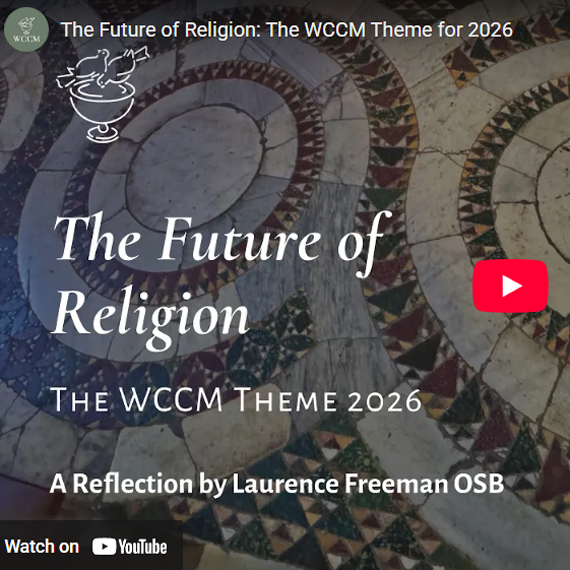
WCCM’s theme for 2026 is ‘The Future of Religion’ and asks ‘How can spirituality evolve to meet today’s challenges’. The theme will be addressed over the eight remaining online talks spread over the year, delivered by eight renowned speakers, Click on the image to the right for more details.
The Unheard Music by John F Deane
And then, in our sleaky, homemade boat, out
on the lake, we both fell silent, the oars, lifted
and dripping water on the surface, soft, softly,
something incomprehensible holding us, fragrance
breathing from the heathers, the low hills embracing,
and lake-water tapping gently against the timber bones
of the craft: we drifted, a long sustaining moment
in unannounced communion, as childhood drew
nearer to the rough-rock shores and our leaning bodies
grew firmer towards the tasks ahead; until
we rowed again, oars raking against the rowlocks, silence
persisting deep within us, swelling to a form of prayer
from Jonah and Me, (Carcanet, 2025)
Reflection by Norl Keating:
John F. Deane was born on Achill Island, Co. Mayo. He has won many awards for his poetry and is a member of Aosdána, which honours artists whose work has made an outstanding contribution to the arts in Ireland. His latest collection, Jonah and Me, was published in December 2025 and contains this beautiful poem, a masterpiece of quietude.
For me, the poet paints a picture from a vantage point high above, looking down on a still, calm lake as the pair of rowers take a pause on their journey to rest briefly and to enjoy the silence. Laurence Freeman reminds us that, ‘according to Thomas Aquinas, contemplation is the simple enjoyment of the truth. Simple, without analysis, without planning, without having to explain it all, without having to control it – the simple enjoyment’ of truth. The opening lines of this poem describe such a moment beautifully: out/ on the lake, we both fell silent, the oars, lifted/ and dripping water on the surface, soft, softly,/ something incomprehensible holding us
The poem might be said to serve as a near-perfect allegorical map for the practice of meditation, describing as it does an organic shift from ‘doing’ to ‘being.’
In meditation practice, the first step is often the hardest: we must stop rowing. Our busy daily lives are defined by the metaphor of the oars – the constant striving to steer, propel, and control the direction of our lives. We build our identities – (the homemade boat) and we push them forward towards our planned, current destination. Those who meditate will be drawn to see the practice of contemplation represented in the lifting of the oars, which is a deliberate decision to cease forward momentum. Deane captures the resulting quiet referring to the lifted oars dripping water on the surface, soft, softly,/ something incomprehensible holding us, fragrance/ breathing from the heathers, the low hills embracing,/ and lake-water tapping gently against the timber bones/ of the craft. Every word chosen by the poet is like a considered brushstroke in a landscape painting. And the words resonate so well with our experience of meditation – the dripping water from the rested oars recalls the slow letting go of our thoughts; when we settle into the silence, we still ‘hear’ the residue of our doing as thought after thought floods the shore of our consciousness. We allow them to drip off us, soft and softly as we choose to simply be.
And as the silence deepens the heart becomes aware of something incomprehensible holding us – this is the unheard music of the title which we apprehend with the eye of the heart rather than comprehend it with our mind. Our practice teaches us that we do not need to constantly think our existence into being; in silence we discover we are moved beyond thinking into a deep, albeit ineffable, awareness of Reality. Once we set aside all doing, including thinking about doing, once we enter the deep silence we can hear the unheard music.
The poet uses a wonderful metaphor that describes our state of consciousness as we experience the silence. The lake-water tapping gently against the timber bones/ of the craft evokes the felt sensation of the heart beating within us in the stillness and silence, as we sit in a long sustaining moment/ in unannounced communion. Our consumer society values doing over being and tends to view drifting as unhelpful but our poet reframes it as a long sustaining moment. This reflects our understanding of meditation as a time of renewing and deepening our spiritual sensitivity. In meditation we choose to leave ourselves open and vulnerable to a graced encounter with the Divine, which occurs at a level of consciousness deeper that our everyday, ‘doing’ consciousness. – we become willing rather than wilful, allowing the encounter to transform our way of seeing and being in the world.
The poem ends where it must: back in the world of action. We cannot stay on the lake forever; we must pick up the oars again. And we find, as we return to the realm of doing, that our bodies grow firmer towards the tasks ahead … silence/ persisting deep within us, swelling to a form of prayer. We apprehend that the quality of our action has changed. Our doing is now informed by our deeper sense of being – the unheard music – which persists deep within us.
This is why we meditate – not to escape the world, but to change how we re-enter and engage with it.

