


Since January 2026, Christian Meditation Ireland and Balally Parish in South Dublin have held a monthly series of events on the Rule of St Benedict usually on the last Saturday of each month from 3 pm to 7 pm. The program explores how ordinary men and women can strive to live the Benedictine Rule in the course of their everyday lives in the modern, busy world.
There will be no meeting in August – the next event will take place on Saturday, 19 September, beginning at the earlier time of 11 am and concluding with a Vigil Eucharist at 6 pm. The guest speaker will be Judith Valente, author of ‘How To Be A Contemplative‘ and a retreat leader on living a more contemplative life and discovering inner wisdom through poetry.
She will give three talks during the day beginning at 11 am with ‘Yearning for Life: On Walking Up in the Prologue of the Rule.’ Following a light lunch at 1 pm, her second talk at 2 pm will address the theme ‘Linking Arms: A 21st Century Vision of Community.’ Following a coffee break at 3 pm, the final talk at 4 pm will speak to ‘Relationship Repair in the Rule of St Benedict’.
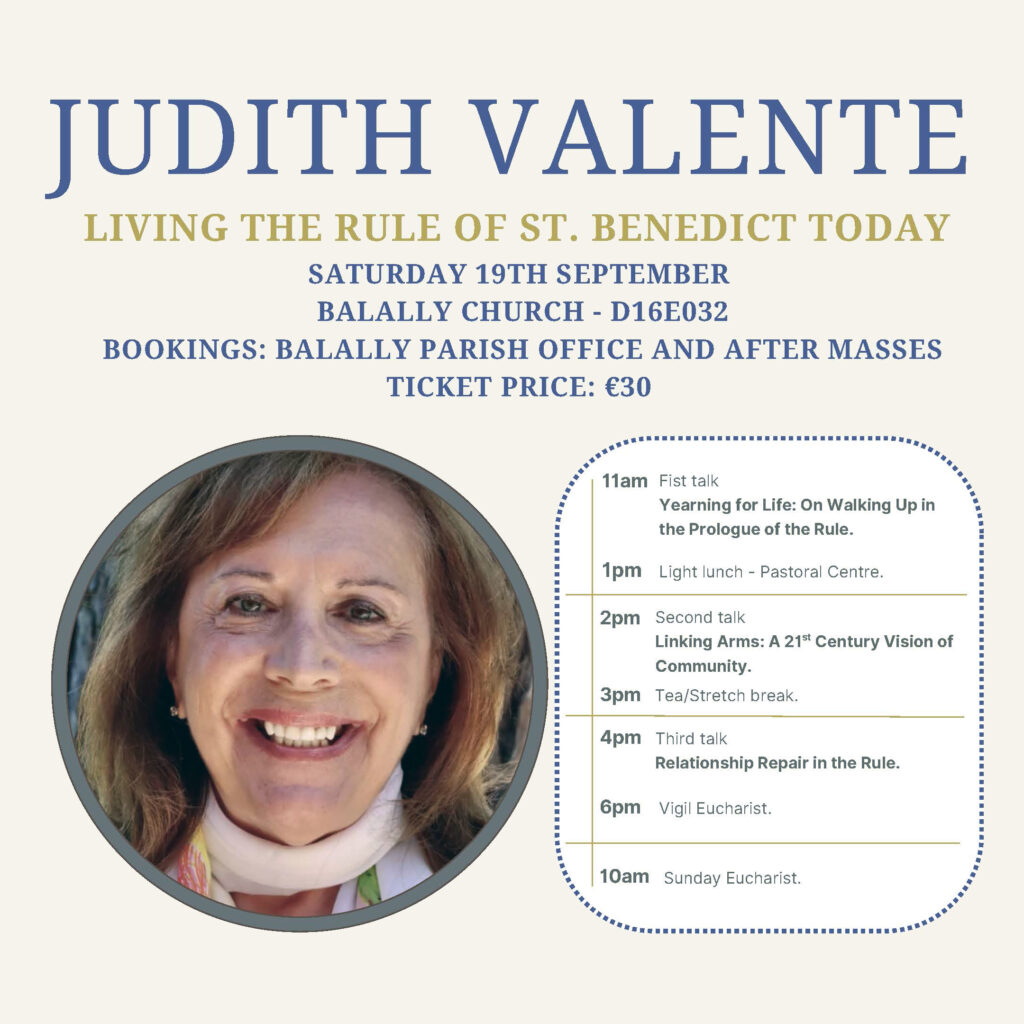
Judith is an oblate of the Benedictine monastery of St. Scholastica in Atchison, Kansas. Her most recent books include ‘How To Live: What The Rule of St. Benedict Teaches Us About Happiness, Meaning and Communty‘ and ‘The Art of Pausing: Meditation for the Overworked and Overwhelmed.’
The fee for this event is €30 including lunch and refreshments. For further information email cinziaangius@balallyparish.ie
The final three talks in the series will take place on Saturday, 31 October, Saturday 21 November and Saturday 12 December from 3-6 pm.
The annual Dermot Lane Seminar, in honour of theologian Dermot Lane, PP Emeritus of Balally Parish, will take place on Saturday 03 October 2026 from 10 am to 1 pm. The guest speaker, Dr Tony Bates, is a renowned clinical psychologist, writer, and national mental health leader with over four decades of experience in clinical practice,
Dr Bates will address the theme Awakening the Heart from a contemplative and a psychological perspective.
Tony is the founder and former CEO of Jigsaw – The National Centre for Youth Mental Health. He was co-editor of Ireland’s National Mental Health Policy ‘A Vision for Change‘, and pioneer of psychotherapy and mindfulness-based interventions. He is also the author of three best selling self-help books on depression, trauma, and mental health care

God’s Ear by @frankdpoetry https://substack.com/@frankdpoetry
Reflection by Noel Keating
Below the ritual
is their raw trauma;
I offer God’s ear.
As each wonder comes in
I slow to match their pace
or race to catch up.
One doesn’t stop to breathe
hammers home his complaints
nailing me for God’s punishments.
Another sums up her life story
as she sees it coming to an end.
She needs to rehearse her eulogy.
I put aside the gavel of judgement
offer one big ear to let them in,
to hold their pain.
Some need the low-lit privacy
to reveal their mental illness
to let me hear the voices in their brain.
Sure, some bring peccadillos,
the crumbs of scrupulosity,
to brush from their laps.
But a mother breaks my heart
with her adult heart break.
Next, her seven-year-old girl,
a miniature of her mom,
makes her first confession
so sweet it hurts.
All are absolved, their regret
is their penance. I pray they find
God’s grace on the far side of hurt.
In our poem, God’s Ear, we are invited to witness the exhausting intimacy of holding and responding to another person’s pain through the low-lit privacy of the confession box. The poem captures the essence of authentic spiritual accompaniment, from the perspective on the one hearing confessions. As I grew up in the 1950s in Ireland, we were encouraged to go to confession every week to repent our sinful ways, even though we were only children. The priest confessors varied a great deal in their approach. Some appeared to take pleasure in wielding the gavel of judgement while one in particular offered a kind, listening, supportive ear; he minimised our petty offences and reminded us that God loved us for who we were and praised our desire to please God.
Frank O’Connor’s short story ‘First Confession’, first published in 1935 and again in a revised version in 1951, captures the bewilderment of a young boy, Jackie, facing the daunting task of confession in 1950s Ireland. His teacher, Mrs Ryan, wields the gavel of judgement, instilling fear in the children by emphasizing the eternal damnation as the consequence of sin.
“Hell had the first place in her heart,” Jackie notes with unease. Her dire warnings feed Jackie’s anxiety, making him believe he has violated all ten commandments, and heightening his dread of confession. Luckily, the priest confessor he encounters takes Jackie’s confession seriously, treating the boy’s admission of murderous thoughts towards his grandmother and sister with surprising understanding. Jackie feels validated by the priest’s attention and finds unexpected camaraderie in his grievances against the women in his life.
The narrator of our poem is another confessor with a big heart and considerable sensitivity – as each wonder comes in/ I slow to match their pace/ or race to catch up – who sees their role as God’s ear – Below the ritual/ is their raw trauma;/ I offer God’s ear. a portal to a forgiving and loving Divine Presence. His is not a judging presence – I put aside the gavel of judgement/ offer one big ear to let them in,/ to hold their pain. A mother breaks their heart/ with her adult heart break/ while her seven-year old daughter, a miniature of her mom,/ makes her first confession/ so sweet it hurts. The confessor ensures that they all know they are absolved, their regret/ is their penance and prays that they find/ God’s grace on the far side of hurt.
Our poem opens with the words Below the ritual/ is their raw trauma;/ I offer God’s ear. The first two lines point to the reality that formalised religion – and polite social conventions – often mask a deeper, unresolved wound. The same can be true of ritualised prayer in which our own wordy prayers and busy thoughts can become rituals that serve to keep us safely insulated from our own rawness and from personal experience of the Divine. The descriptions of the various penitents mirror our experience when we first sit down to meditate: One doesn’t stop to breathe / hammers home his complaints… / Another sums up her life story/ … some bring peccadillos,/ the crumbs of scrupulosity,/ to brush from their laps. Which of us will not immediately recognise each of these descriptions as part of the waves of thought that ebb and flow on the shores of our consciousness as we begin to meditate. Our ego constantly hammers home its complaints, desperate to be heard and validated.
Our practice of contemplative prayer, through the faithful repetition of a single word, invites us to do inwardly exactly what the poet advises: to stop the chatter, drop our judgments, and become open and receptive to the Other. While we do not fight the thoughts, neither do we let them carry us away. We simply acknowledge them and gently return to our word, slipping again and again beneath the noise. By committing to the poverty of a single word, we cease trying to actively manage or control our experience. As John Main observed: ‘The silence is there within us. What we have to do is to enter into it, to become silent, to become the silence. The purpose of meditation and the challenge of meditation is to allow ourselves to become silent enough to allow this interior silence to emerge. Silence is the language of the spirit.’ Persevering in our practice of stillness and silence helps us to find/ God’s grace on the far side of hurt.
One final observation on the title of this poem – one of the fruits of our practice is that we are drawn to become God’s ear for others. The poem and the practice of meditation both reveal the same truth: the greatest spiritual gift we can offer another human being is not an answer to their difficulties, but the spacious, silent refuge of our undivided, non-judgemental attention, helping others to honour their own authentic personal spiritual experience.

