

Welcome to our first newsletter of the new school year. By now you will be getting to know the new faces sitting in front of you each day and you will be helping the children in your care to feel a sense of belonging to their class and their school. One way of helping your new group to get settled is to quickly resume the practice of meditation in your classroom.
Meditation is really good for children. It promotes their sense of wellbeing and belonging and they take to meditation like ducks to water. All you have to do is begin. Remember that the lesson plans can be found here.
When resuming the practice all you will need to do is remind the children of the basics of Lesson 1: to sit with their backs straight and both feet firmly touching the floor; then, to let go of all thought by reciting their word in four equal syllables for the whole time of the meditation. And return to it gently and lovingly when they realise their mind has wandered. In Christian schools we use the word ‘Ma-ra-na-tha‘, saying it silently in our minds so no one else can hear us. The meditation timers can be found here.
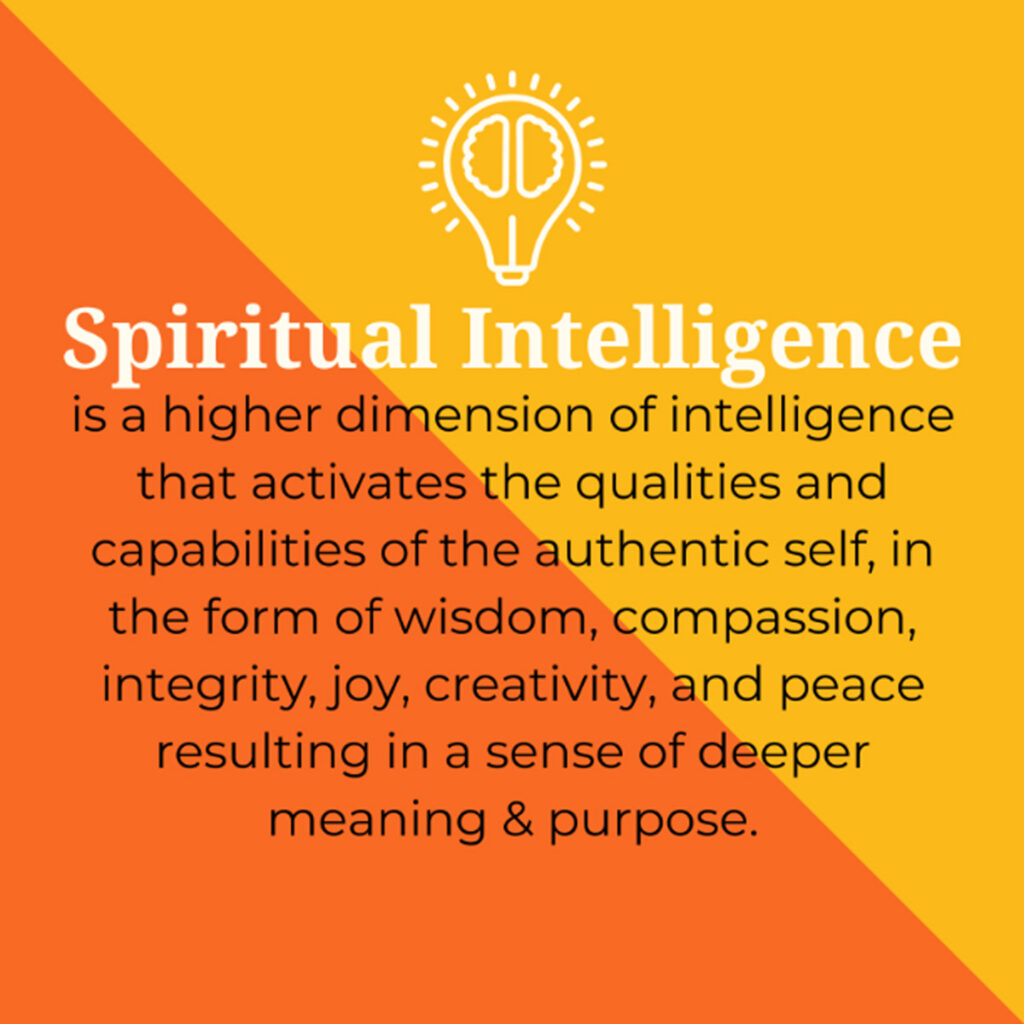
“Spiritual Intelligence (SQ) is the human capacity to access deeper meaning, values, and purpose. It helps us align our actions with what truly matters.”
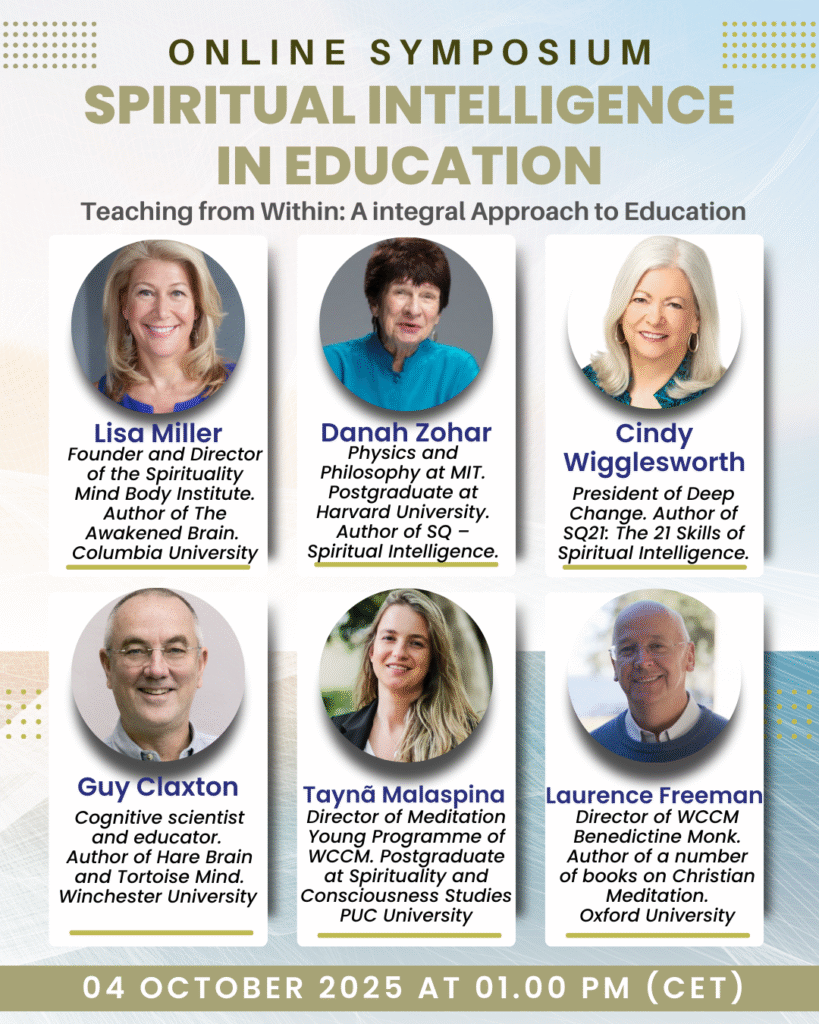
You are invited to join us for the Spiritual Intelligence in Education Online Symposium which takes place over Zoom on Saturday, 04 October 2025 starting at 12 noon. The theme of the symposium is Teaching from Within – An Integral Approach to Education, where leading experts will explore the profound connection between spirituality and learning. In a time when youth mental health challenges are on the rise, this symposium brings together renowned speakers to share cutting-edge research, practical insights, and transformative strategies for fostering well-being, resilience, and deeper meaning in education.
Thought leaders Danah Zohar, Lisa Miller, Cindy Wigglesworth, Guy Claxton, Taynã Malaspina and Laurence Freeman will discuss how promoting spiritual intelligence can enhance teaching and learning, support emotional well-being, and cultivate a more holistic approach to education.
Whether you are an educator, school leader, researcher, or simply passionate about the future of education, this symposium offers a unique opportunity to gain valuable perspectives and practical tools. The suggested registration fee of £75 (stg) reflects the need to achieve self sufficiency. If you need a concession – or to allow several teachers from your school to attend for a reduced fee – please let us know by filling this form here. We do not turn anybody away for lack of resource.
The Programme
12:00 – 12:30 pm Introduction (Taynã Malaspina): How can Spirituality help the Next Generations?
12:30 – 1:15 pm Talk 1: (Danah Zohar): How Schools can Address the Youth Mental Health Crisis using the 12 Principles of Spiritual Intelligence
1:15 – 2:00 pm Talk 2 (Lisa Miller): The Awakened Brain: Science of Realizing your Spiritual Awareness for Joy, Health and an Inspired Life
2:00 – 2:15 pm Break
2:15 – 3:00 pm Talk 3 (Cindy Wigglesworth): The 21 Skills of Spiritual Intelligence – The Next Step beyond Emotional Intelligence
3:00 – 3:45 pm Talk 4 (Guy Claxton): Grounded Spirituality: Young People thirst for Quality of Experience
4:45 – 5:30 pm Closing (Laurence Freeman): Where has the Joy gone? Reconnecting with our True Selves
5:30 – 5:45 pm Questions and Answers
To register for the symposium, click on the image above and scroll down to the end of the page.
This Thing In You by Julia M Fehrenbacher
This thing in you
will not take no for an answer.
This that somehow
shines strong
beneath the heavy hard hurry
of your conveniently
noisy life. This shapeless
something that shows up
everywhere—
even when you forget
to notice.
It does not
understand safe
or sensible, will not let you
get away with half-hearted
lifeless lies.
It’s that wordless
something
that does not know how
to be quiet. It will continue knocking
until you throw open
the door. Until you become
Ablaze. Awake. Madly in love.
The dazzling artist
of your own
wild life.
Reflection by Noel Keating: I’m intrigued by this poem because the language it uses is so very ordinary and its structure is straightforward. The sentences are broken up into short phrases and that forces us to slow down the pace of our reading, to consider each phrase as a gift that has the potential to inspire us.
What is this thing in you? Although the poet doesn’t name it, she nonetheless heightens our awareness that something vital lies deep within us, which if we would access it has the capacity to enrich and deepen our lives. Although she doesn’t name it, our poet describes the quality of this ‘something’ – it is ‘wordless’ and ‘shapeless’; yet it ‘shines strong’, ‘shows up everywhere’, ‘does not know how to be quiet’, ‘does not understand half-measures’; and it is persistent, it ‘will keep knocking’ until you awaken!
Despite the absence of overtly spiritual language, the poem is deeply contemplative and spiritual. Its power is exemplified in the last few lines as the potential of this ‘thing’ is made manifest. This ‘wordless something’ will cause you to ‘throw open the door’ and light a spark within you so that you become ‘ablaze, awake’ and ‘the dazzling artist of your own wild life’.
But note whose responsibility it is to throw open the door. This thing will knock and knock, but it is YOU who must throw open the door, the door of your heart, that metaphorical centre of our spiritual sensitivity. This thing is in each one of us, it is innate in every human person, it is a gift waiting to be activated. This is why we meditate, to release its energy into our lives. As Laurence Freeman writes: ‘What we need to do is to find a way to just wake up, and understand that we are holy, filled with the holiness of the Spirit. This is meditation’. He also wrote that ‘The most revolutionary thing in our lives is self-knowledge, to awaken to ourselves as we truly are. To cut through the illusions and the images of the ego, to cut through what we want other people to think about us, to let all of that go and just to be ourselves – that’s the most revolutionary thing in the world. And it’s the revolution of the gospel, to come to that self-knowledge. And it not only changes us, it changes the world that we are part of … in which we are living and making our contribution.’ Meditation empowers you to become ‘the dazzling artist of your own wild life’ by yielding to what you already are, by allowing this thing in you to be the centre from which you live out your life.

