Registration for our Summer Course 2025 is now open – please pass on the word to anyone you think may be interested. This highly engaging course will offer a range of holistic well-being activities across the primary curriculum for the mutual wellbeing of teachers and children. It will also enable schools to meet the requirement to initiate a wellbeing promotion review as part of their school planning process.
The Course will be delivered by Dr Noel Keating, Bryan O’Reilly and Regina Doheny from Tuesday 01 July 2025 to Saturday 05 July 2025 inclusive. Click here or on the image to register or find out more.
Participants from previous years have found the course to be professionally enabling and relevant to the work of their schools, as well as personally enriching and transformative. Many considered that the combination of personal and professional learning was a key feature of the course for them.
Mind Wanting More by Holly Hughes
Only a beige slat of sun
above the horizon, like a shade pulled
not quite down. Otherwise,
clouds. Sea rippled here and
there. Birds reluctant to fly.
The mind wants a shaft of sun to
stir the grey porridge of clouds,
an osprey to stitch sea to sky
with its barred wings, some dramatic
music: a symphony, perhaps
a Chinese gong.
But the mind always
wants more than it has –
one more bright day of sun,
one more clear night in bed
with the moon; one more hour
to get the words right; one
more chance for the heart in hiding
to emerge from its thicket
in dried grasses – as if this quiet day
with its tentative light weren’t enough,
as if joy weren’t strewn all around.
from America Zen: A Gathering of Poets (Bottom Dog Press, 2004)
Reflection by Noel Keating: I like the double meaning behind the title of this poem: ‘Mind Wanting More’. On the one hand it seems to be about the mind wanting more and more. But if we see the word ‘mind’ as a verb it become a warning to mind wanting more – to be careful about what we wish for.
We know from our daily practice that the mind is never satisfied for long – it always wants more. More excitement, more understanding, more truth! It doesn’t matter what the object of the desire is, the mind always seems to want more of it. As our poet describes: one more bright day of sun, one more clear night in bed with the moon; one more hour to get the words right.
Our daily meditation teaches us how difficult it is to be fully present to the present moment because it becomes so preoccupied with our daily concerns, desires and worries. Meditation, then, is ultimately about letting go of our preoccupations so that we can learn to simply be. As Laurence Freeman writes ‘Meditation is fundamentally the dynamic of dispossession, a dying to the ego self.’ Meditation ‘leads us out of the closed boundaries of the ego and into the infinite otherness of God.’ Every period of meditation is one more chance for the heart in hiding to emerge from its thicket in dried grasses and to realise that indeed this quiet day with its tentative light is enough; that joy is in fact strewn all around.
Letting go isn’t easy. John Main, writing in Word into Silence, observes that ‘It requires nerve to become really quiet. To learn just to say the mantra and turn away from all thought requires courage … Meditation is the prayer of faith, because we have to leave ourselves behind before the Other appears and with no prepackaged guarantee that He will appear. The essence of poverty consists in this risk of annihilation.’ In Moment of Christ he writes that ‘This is the dying to which we are summoned, if we are to enter with our whole being into the movement of death and resurrection which is the great axis of the Christian life.’ Laurence Freeman reminds us that ‘It is not enough to think this movement, to imagine ourselves making it, or even to believe that this indeed is the ultimate axis of reality. We are invited to hand over our whole selves to that death of self-consciousness. Meditation is the means by which we hand ourselves over, and hold nothing back.’
We need to be wary too that, even in the simplicity of our daily practice, our daily letting go, that the mind will want more – more intellectual understanding, more of a sense of achievement, more awareness of a deepening spirituality, more holiness. These too we must let go. A woman told Suzuki Roshi, the Japanese Buddhist Monk who founded a Zen Centre in San Francisco, that she found it difficult to mix Zen practice with the demands of being a housewife. ‘I feel I am trying to climb a ladder’, she said. ‘But for every step upward, I slip backward two steps.’ ‘Forget the ladder,’ Suzuki told her. ‘In Zen everything is right here on the ground.’
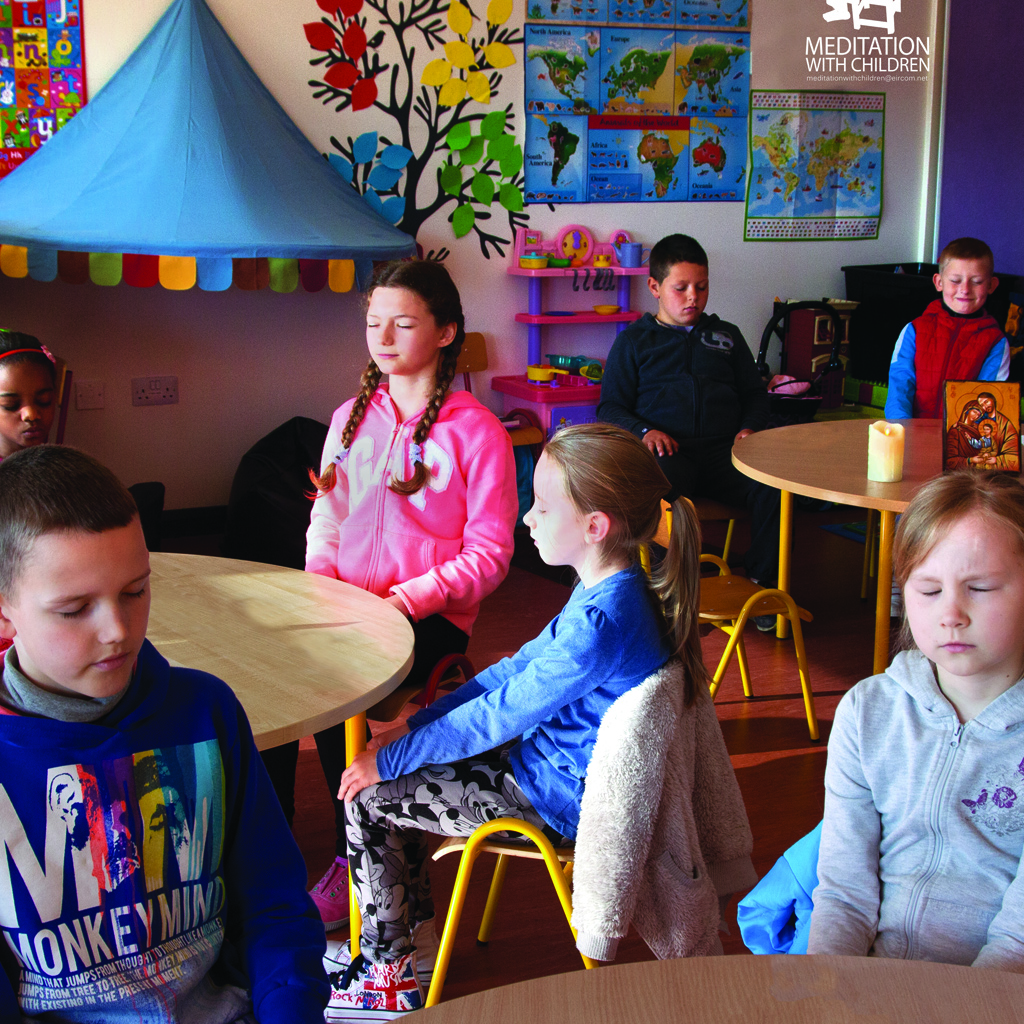
Why not meditate now with the children in your classroom and give their hearts – and your own – one more chance to emerge from hiding in its thicket of dried grasses.