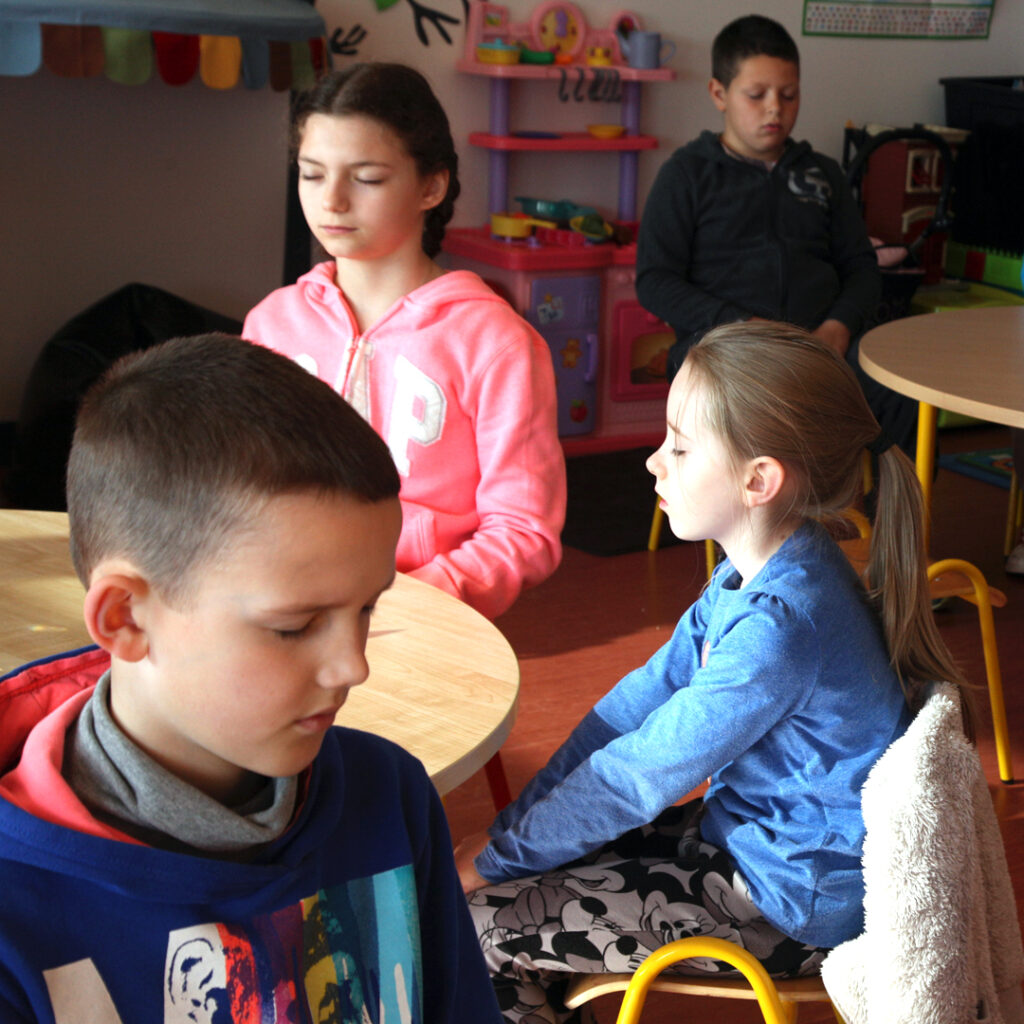

When children take on a commitment for Lent they quickly learn that it isn’t easy to persevere with it. But they also learn the value of seeing it through. It is the same with meditation, especially when we take it up as a commitment to a regular practice. It is easy to begin but not so easy to persevere.
Have you encouraged the children in your classroom to meditate at home during Lent? Have you renewed your commitment to meditate at least twice every week? If the thread has broken, perhaps now during Lent is a great time to get started again!
When we meditate we bring our attention to into our body and that helps to still the mind. Our body is always where we are, in the present moment, while our mind can be anywhere and often stuck in the past or the future. We bring our attention to our body firstly by checking our posture – that we are sitting up straight so our breath can flow freely; and we check that we have both feet firmly on the floor. That helps to ground us in the present moment and we then bring our attention to the repetition of our word ‘Ma-ra-na-tha’.
Some years ago we wrote two simple songs for before and after meditation. The video ‘Love is Calling‘ explores the opening ditty. The meditation timers on my YouTube page for beginners include the opening and closing songs. If you haven’t tried them, click here and use one for your next meditation.
You can download the the music and the music sheets for both songs below. Why not download them and teach them to your class or even to the whole school?
Love is Calling: Music and Music Score When We Meditate: Music and Music Score
Self-Care by James Crews
Some days it feels like a foreign language
I’m asked to practice, with new words
for happiness, work, and love. I’m still learning
how to say: a cup of tea for no reason,
what to call the extra honey I drizzle in,
how to label the relentless urge to do more
and more as poison. And how to translate
the heart’s pounding message when it comes:
enough, enough. This morning, I search for words
to capture the glimmering sun as it lifts
above the mountains, clouds already closing in
as fat droplets of rain darken the deck.
I’m learning to call this stillness self-care too,
just standing here, watching goldfinches
scatter up from around the feeder like pieces
of bright yellow stained-glass, reassembling
in the sheltering arms of a maple.
from One Art, edited by Mark Danowsky.
Reflection by Noel Keating:
I have chosen this poem for today in honour of the season of Lent which began yesterday. As I grew up in the 1950s there was a strong emphasis on ‘giving-up’ something for Lent – as children we often gave up sweets and biscuits for the six weeks of Lent as a form of self-discipline and as an atonement for our sins. But at its ancient heart, Lent is not about deprivation; it is about clearing. It is the deliberate work of consciously stripping away the unnecessary to reveal the essential.
In his poem Self-Care, Crews writes about the challenge of taking the time to be still, to let go of the relentless urge to do more/ and more. The irony here is that as a wordsmith he faces the task of how to label the relentless urge to do more/ and more as poison. And how to translate/ the heart’s pounding message when it comes:/ enough, enough. Although it may be for him a labour of love, it is still a labour. And like the rest of us, he finds it difficult to let go of the idea that if he isn’t producing, he isn’t worthy. He is still learning how to say: a cup of tea for no reason.
Might this be the ‘sin’ that Lent invites us to examine; not a moral failure, but a spiritual misalignment. We have come to believe that we are what we do, rather than come to know who we are in the depths of our being, the relentless urge to do more/ and more. Traditionally Lent has been seen as a time of fasting but perhaps what we really need to fast from is our addiction to doing and all of its accompanying noise.
Our commitment to our meditation practice is a form of resistance to that addiction. Meditation is the radical act of sitting down and doing nothing else, in a world that demands everything. A practice where we determine where our attention dwells, rather than yielding to the algorithms of social, entertainment and news media. When we sit in the stillness and silence of meditation, we are engaging in true-self care. We are not pampering our egoic selves, but reclaiming our true-selves. We know the mind will intrude into our practice as it itches to plan, to fix, to solve. But our practice teaches us how to allow such urges to arise and let them fall away, one by one, returning gently every time to our mantra.
Perhaps this Lent you will choose to fast from the relentless urge to do more/ and more and feast instead on Silence and learn to call this stillness self-care – true-self care. While Lent is just a liturgical season and we need to practice meditation all year round, Lent give us pause to deepen our practice, to deepen our resolve to open our hearts to the silent Presence that is always present to us. And see that Presence not just in our times of meditation but also at other times when we are just standing here, watching goldfinches scatter up from around the feeder like pieces of bright yellow stained-glass, reassembling in the sheltering arms of a maple. May you find that in moments like these, we are reassembled too.