

Children who give up something for Lent or who take up something new for the Lenten season discover something important about perseverance. They learn that it isn’t easy to persevere with any commitment over the longer term; they learn that they may not always succeed but that they can start afresh the next day. It is the same with meditation, especially when we take it up as a commitment to a regular practice. It is easy to begin but not so easy to persevere.
The same is true of meditation in school. Since we began our meditation in schools project in late 2012, over 280 primary schools in Ireland have taken up the practice so that over 56,000 children have been introduced to meditation. It is not easy to maintain the practice twice or more each week but schools too learn that they can persevere; and if the habit is broken for a while that they can restart it at any time.
John Main reminds us that ‘our daily meditation is an entry into the supreme conviction that God has revealed himself in Jesus and that Jesus reveals himself to us in our hearts. … [It] is a time of profound joy. It is the peace beyond all understanding, beyond all words, concepts or analysis.’
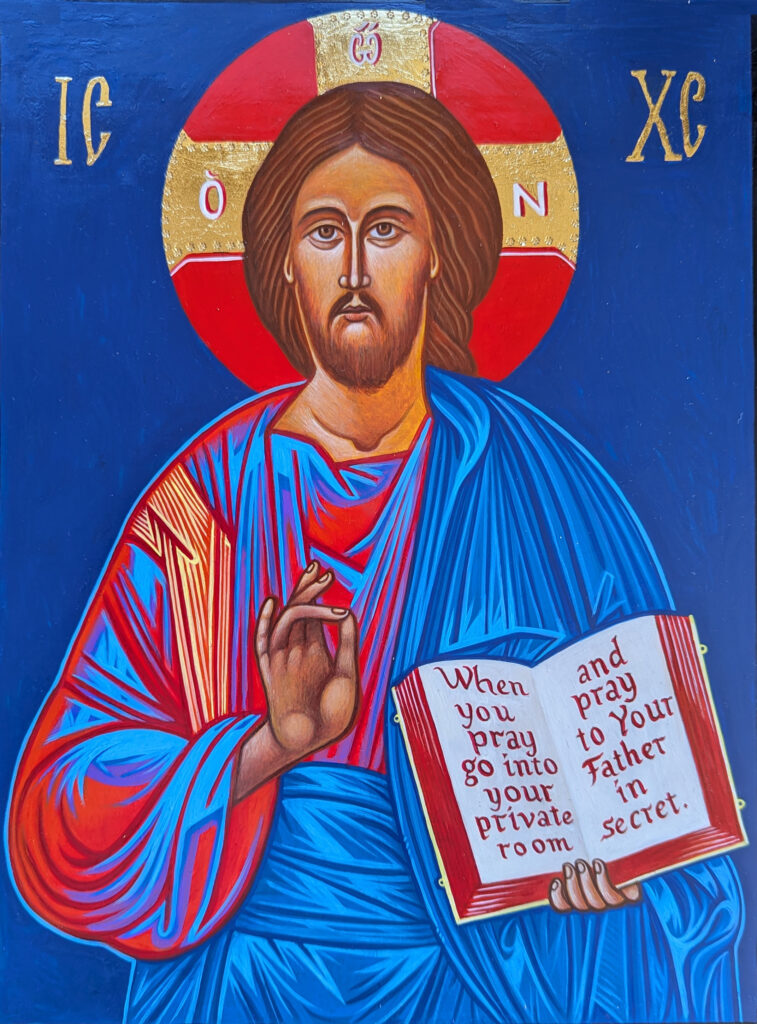

In our tradition of meditation, we sit when we meditate. We do so because meditation is a state of alert relaxation. The standing position is one of action or getting ready to act while lying down typically aims at complete rest. Sitting lies half-way between these extremes and so is ideally suited for a time of alert relaxation.
When we meditate we bring our attention to into our body and that helps to still the mind. Our body is always where we are, in the present moment, while our mind can be anywhere and often stuck in the past or the future. We bring our attention to our body firstly by checking our posture – that we are sitting up straight so our breath can flow freely; and we check that we have both feet firmly on the floor. That helps to ground us in the present moment and we then bring our attention to the repetition of our word ‘Ma-ra-na-tha’.
Laurence Freeman has prepared a series of videos on learning to meditate during lent which may be of interest – the first of the series can be accessed by clicking here.
For teachers who would like to refresh their understanding of Christian Meditation, this short animated video is worth watching.
The Teacher’s Report I’d Give Myself Right Now by Julie Barton
Julie is a petulant, reluctant, stubborn
student who does not like change.
She likes when something works, but then
she tries too hard to repeat the unrepeatable.
She can be short-sighted and risk averse.
She is letting fear win too often.
It is possible that she has finally realized
that she must give up doing what is safe.
Today in the mirror, she reported a glint
in her own eye when she thought of
blowing it all up, seeing what happens.
I do see potential in that tiny pinprick
of light in her speckled brown iris. May she
continue to embrace artistic destruction
followed by wild, unleashed creation.
from Out With Lanterns, a daily poetry practice (6 Feb 2025)
Reflection by Noel Keating: This poem was inspired by a phrase from Salman Rushdie who wrote that ‘Each book has to teach you how to write it. I like the concept behind this poem – imagining how would an objective, loving teacher might write a brief report about you, essentially about how you approach life, how your being in the world is enabled and constrained by your conditioning. The poet does not describe the task in this way but that is what I think she has done.
It is difficult, is it not, to be objective about ourselves. We are always, as it were, ‘on our own side’, biased in favour of ourselves, seeing our motives as always pure and very often fail to see the things in our conditioning that lead us to make our choices. And, of course, it is difficult for any other person to read our inner thoughts or to appreciate what caused us to behave in a certain way – but others will observe how we act and will inevitably surmise the reasons behind our actions.
What would the first line of a poem about you say? Think for a moment of the things that typically preoccupy your thoughts when you sit down to meditate. What kinds of thoughts intrude most frequently and what does that tell you about your insecurities? But don’t be misled by those – we all have insecurities and we so often make the mistake of running ourselves down when we would never run a friend down for the same thing! Shirley Chisholm, the first black woman elected to the United States Congress in 1968, once wrote that ‘We must reject not only the stereotypes that others hold of us, but also the stereotypes that we hold of ourselves.’
Ask yourself ‘what would your partner or best friend say about who you really are?’ – someone who loves you for who you are and not merely for what you do for them? Someone who knows you for all your little foibles but who recognises foibles for what they are! Someone who can see the real you underneath your insecurities. What would they say about you? Meditation helps us to discover our true-self; to see ourselves for who we are in God and who God is in us. Meditation gives rise to the growth of contemplative consciousness within us and in society. Mirabai Starr writes that contemplative consciousness ‘is a way of seeing—beyond the turmoil, the rights and wrongs, the good guys and villains – to the radiant heart of things’. Is that not what this poem is about – an objective, loving person trying to help another to discern their fullest potential, to get a sense of their true-self.
In Jn 10:10 Jesus tells us that ‘I have come so that they may have life and have it in abundance.’ John Main reminds us that the Christian vision is one ‘of transcendent unity’ where all humanity and creation is united through Christ … into the unity of the divine harmony itself. ‘Our call’, he writes, ‘is the challenging call to wholeness, to oneness, to union.’ And the first step is to become one with ourselves, to integrate all aspects of our being, to centre our doing in our deepest sense of being.
Our meditation practice is a step on that journey to unity and we begin anew every day; twice each day we faithfully take another step into the mystery of our being. John Main reminds us that we must ‘follow our way with simplicity, with humility and with gentleness. We must learn to be very gentle with ourselves as we learn to root the mantra in the heart. Only the smallest effort is required. Everything is given to us and basically what is asked of us is only that we are faithful to the daily pilgrimage and that we give the pilgrimage first place in our lives. Fidelity leads us to realize that the gift is being given. Then, as each morning and evening we turn faithfully to our meditation and during our meditation remain faithful to the mantra, the gift reaches us, the cycle is completed.’ And he concludes, ‘there is no greater act of social or political or religious responsibility that any of us could undertake than to become more fully conscious, more fully rooted in consciousness, in God.’ Only then will we be able to live our lives with true inner freedom, with wild, unleashed creativity.

