
Over the coming days, please remind the children in your class to continue to meditate over the Summer. It might be a good idea to encourage them to meditate at home at least once a week as part of their ‘homework’ – reminding them that meditation helps them to grow in love.
Wishing You A Great Summer Break
Please remind the children every now and then that saying their prayer word ‘Maranatha’ from the beginning to the end of meditation helps us to take our attention off our selves and give our attention to God’s presence in our hearts.
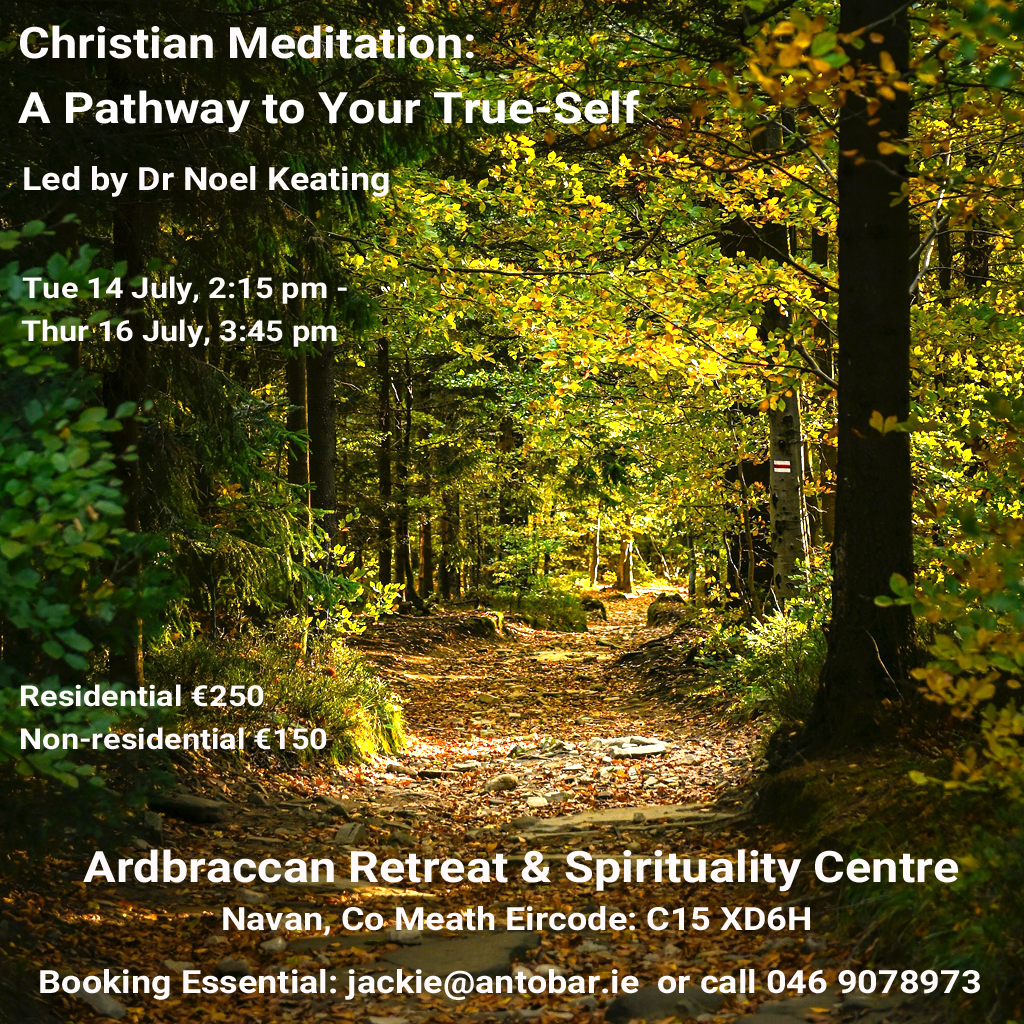
Noel Keating will lead a retreat on Christian Meditation: A Pathway to Your True-Self from Tuesday 14 July (starting at 2;15 pm) to Thursday 16 July (ending at 3:45 pm). The venue will be the at the Spiritan Retreat and Spirituality Centre in Ardbraccan, Navan, C15 XD6H.
Noel, who was National Coordinator for Christian Meditation Ireland for ten years, will use a combination of contemporary contemplative poetry and scripture readings as a way into silence and receptivity. We will discover how the contemplative journey- from the head to the heart – restores harmony between the egoic-self and the true-self, as we discover who we are in the depths of our being.
The retreat will balance teaching, meditation together, time for quiet and opportunities for sharing. While suitable for beginners, this event will enable experienced meditators to deepen their experience of the practice. It will also include an introduction to the practice of lectio divina. Email jackie@antobar.ie to book a place or call Fr Peter Conaty on 046 9078973
Self-Portrait as Seedling by Rosemerry Trommer
To know the self as seedling again.
To push against the home I’ve known
before launching into ecstatic stretch.
To trust again how the slenderest threads
will anchor me to the world.
I had become so enamored with blooming,
I forgot the joy of initiation,
the thrill of not knowing,
the startlement of reaching through
darkness into light.
I’d forgotten the earnest striving
that comes before bud, before petal,
before effulgent perfume.
To be held by it again,
that sacred uncertainty.
To feel the flush of becoming
what I already am.
Reflection by Noel Keating:
Rosemerry Trommer has an incredible capacity for using metaphor to awaken us to some essential truths about spiritual growth that may seem at first glance to be paradoxical. In this poem she reminds us that the transition from a full bloom back into a seedling is not a regression but, a necessary step on the spiritual journey which takes the form of a climbing spiral.
In this poem Self-Portrait as Seedling, she demonstrates the parallel between growth in nature and growth in consciousness – in both cases it is necessary to seemingly let go part of what one has become in order to generate further becoming. The opening stage of a seedling’s life happens entirely in dark earth. As a plant moves from blossoming to the seedling stage over and over again, the apparent loss is ultimately illusory because as we move through stages of growth we don’t regress in our stages of growth but move forward to a new stage.
Trommer clarifies that this cycle not as a punishment, but as a crucible of transformation. Our daily practice is our crucible to which we return, ideally, twice each day. When we sit to meditate, closing our eyes, we consciously step away from the brightness of our daily lives and into a purposeful, internal, generative darkness.
Trommer’s poem captures the quiet, subversive joy of shedding the pressure to always be blossoming and instead welcoming the cyclical return to the fertile dark; it presents us with a map of the soul’s journey back to its essential nature, teaching us how to live with unknowing, open to encountering the sacred with uncertainty, how to abide unknowingly in the knowledge of the heart, without needing to ‘know’ with conceptual certainty. As we move into new stages of growth in consciousness, we retain all the capacities we had at the previous stage but now we see through a broader lens, no longer clinging to older ‘certainties’ and we find we are better able to handle the paradox of unknowing knowing.
Just as the seedling does not see the sun it is growing toward, the practitioner repeating a mantra often feels only the monotony of the practice, the dark quiet of the interior life. Trommer’s seedling doesn’t fight the dirt; it yields to it. In mantra practice, this yielding is the transition from doing to being. The repetition of the word erodes the sharp edges of the ego, burying our superficial identities so that something deeper can take root. As we grow in our practice we rediscover the joy of initiation, / the thrill of not knowing, / the startlement of reaching through / darkness into light.
To become, the seed must break open in the dark, moist soil and this is an excellent metaphor for the psychological letting go that occurs as part of mantra meditation. The act of letting go of our habitual attachment to the defences put in place by the ego, corresponds to the cracking open of the seed. Our practice gives us the courage to push against the home I’ve known/ before launching into ecstatic stretch./ To trust again how the slenderest threads/ will anchor me to the world. In meditation, the home we’ve known is our comfort zone – our egoic identity which is maintained by our cyclical thought patterns and our desire for immediate gratification. The mantra acts as a gentle, persistent force against this casing. Every time the mind wanders and we softly bring it back to the mantra, we are pushing against the imprisoning walls of that old home. We are cracking open the ego to make room for an ecstatic stretch of awareness. Over time, we begin to sense the flush of becoming / what I already am.
This is the ultimate paradox of both the seedling and the spiritual seeker. A seed does not need to learn how to be an oak tree or a wildflower; the blueprint is already encoded within its DNA. It doesn’t look outside of itself for instructions on how to grow. Similarly, the practice of mantra meditation is not about acquiring peace, holiness, or enlightenment from the outside. It is a process of remembering: the repetitive motion of the mantra clears away the debris of accumulated stress and conditioning, allowing us to rediscover our true nature – who we are in God and who God is in us.
By choosing to know the self as seedling again, we give ourselves permission to drop the heavy burden of being a finished product. We find the spiritual fruit of the practice: a deep, unshakable trust in the process of life, resting comfortably in the sacred uncertainty of the present moment, fully aware that we are already whole. Trommer’s poem reminds us that the seedling moves in two directions at once: anchoring deep into the dark earth while simultaneously reaching up toward an unseen light. This is why we meditate.
WCCM has developed a new set of resources to encourage leaders of meditation groups, regional coordinators and others to teach meditation. They have designed a four-session course that can be delivered over four weeks or in four sessions over a weekend.
This four-session course expands the WCCM library of essential teaching resources. The themes for each of the four weeks takes participants on a gradual journey of understanding the practice of meditation within the Christian tradition. Participants are invited into a contemplative experience of knowing God and are invited to explore how this can give meaning and purpose to their life.
The resources include a guide for presenters and a set of four videos, each building on the previous one. They also offer a set of promotional posters which can be adapted to suit your needs. WCCM hopes this guide will support you, the presenter, in helping people to learn to meditate.