
This week we celebrate Catholic Schools Week in Ireland and all Catholic schools will have organised activities to celebrate the event. I hope that schools which practice Christian Meditation on a whole school basis will have used the opportunity to highlight the practice and emphasise that Christian Meditation is ultimately a form of prayer.
We teach children to say their prayers and, for the very many in Junior school, prayer may primarily be the recitation of a prayer they have learned by heart. But as they get older, children are taught to see prayer as having a personal conversation with God about things that are important in their lives: praying for those in need or distress, praying for the health of family members and so on.
Please use this opportunity to remind the children in your class that Christian Meditation is also a form of prayer – a silent, imageless, wordless prayer in which we open our hearts to God. As the Bishops Conference reminds us: ‘In his teachings, Jesus promoted the practice of taking time out for silent, interior prayer‘ and that Jesus ‘was familiar with prayer as a form of silent communion with his father.’
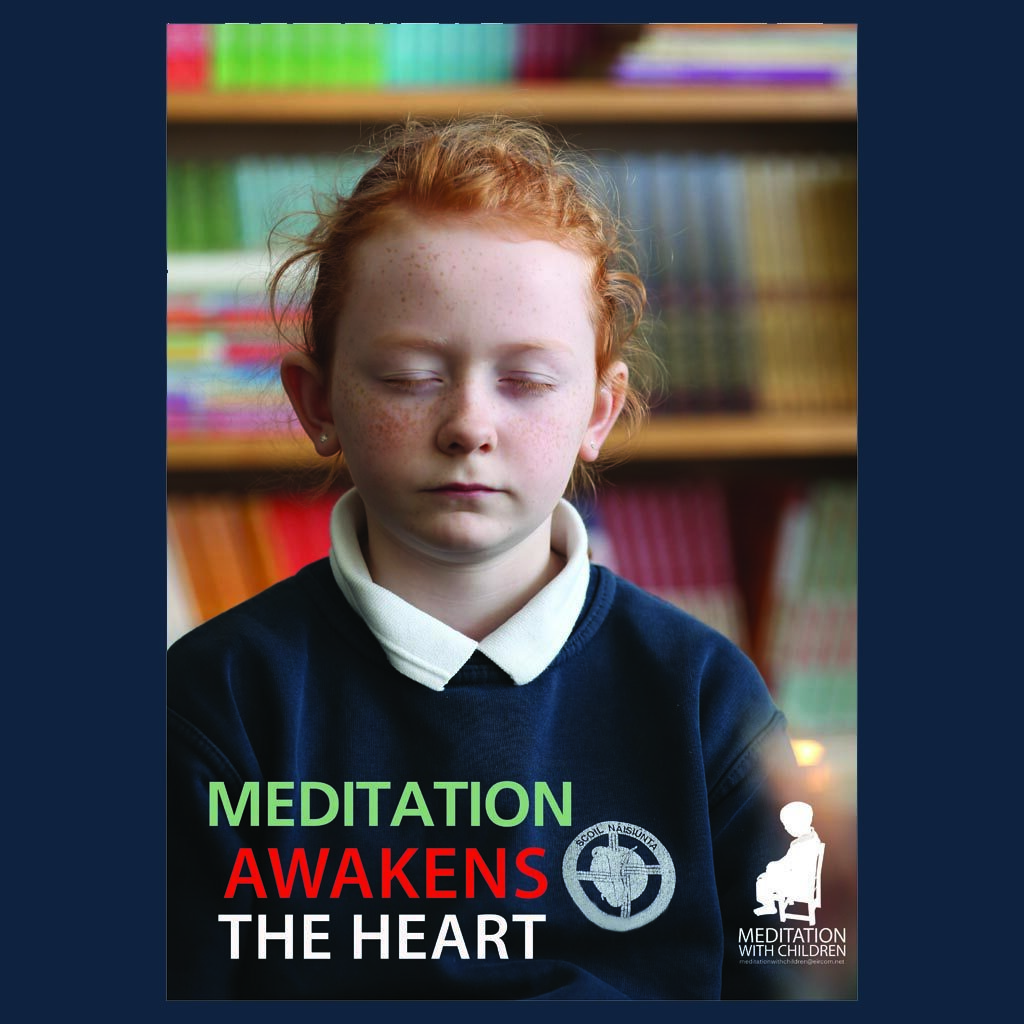
The document, ‘A Reflection on Mindfulness: Rediscovering the Christian Tradition of Meditation and Contemplation‘, reminds us that, ‘with two thousand years of experience, the Christian tradition has a deep vein of spirituality that encourages us to focus on living the present moment in God, taking time out for meditation, and developing a lifestyle of contemplation in action.’ It goes on to say that ‘In addition to the spiritual fruits that arise for Christians, both individually and as community, spending set periods of time in meditation and contemplation also provides us with an opportunity for dialogue with our brothers and sisters of other traditions and to learn from them as they learn from us.’ This makes whole-school meditation an ideal practice today in our multi-cultural schools which are attended by people of all faiths and none, because it is a universal practice across all religious traditions, yet find particular expression in our own Catholic tradition.
The bishops’ document suggests that ‘Schools may wish to consider introducing a form of Christian meditation on a whole-school basis. Teachers
might also consider beginning and ending the day with vocal prayers and also a brief period of silent meditation and prayer.’ It is source of joy that so many schools have already done so. We are currently promoting meditation with primary schools in the dioceses of Kildare & Leighlin and Cork & Ross.
Christian Meditation is a prayer of the heart rather than the mind. When Christian Meditation becomes an integral part of our lives, we begin to live from a deeper level of consciousness. We no longer see ourselves as being at the centre of everything. Instead, we live out our lives knowing that God is at the centre and we strive to live in harmony with God’s intentions for us and for the world. Through our daily practice, we are able to maintain that deep sensitivity to our spiritual nature, and when we do so everything becomes a prayer.
To gain a deeper understanding of the nature of contemplative prayer, which today we call Christian Meditation, click on the video from Laurence Freeman
We would love to hear from you about how meditation is going in your school. Please email meditationandchildren@gmail.com to leave some simple feedback, even a single sentence to confirm that your class is still meditating each week and any comment you wish to make or question you might like to ask!

Prayer by Tonijean Bernbaum
It really doesn’t matter
Where I begin
or how it begins.
It could be a tulip in its last day of bloom
or a baby pine sprinkled with snow
or a walnut in its shell
or a stone from the river bed at a sacred site.
It could be a chipmunk
or the scurrying of a chipmunk
on the pile of fresh cut oak
fragrant in the peripheral
of dawn’s first light.
Could be the deer
eating the apple
or the deer dung
or the emerald patch of moss
where the dung was dropped.
I find it quite impossible
to begin a prayer.
It’s already going on
All the time
everywhere.
In meditation we consciously choose to cease all doing and simply be in the present moment. We opt to let go of our preoccupations, of the desires and needs of the ego for control and domination, for certainty and security; we choose, for the period of our meditation, to set aside our normal state of self-consciousness so that we can be open and receptive to what is directly in front of us.
The poem, by Tonijean Bernbaum, is entitled Prayer. Traditionally, we think of prayer as a mental activity – thanking God for all is good in life, perhaps asking for things for ourselves or the common good and praying for an end to hunger and for peace in our world.
And, while such mental prayer is an important aspect of our prayer life, ultimately prayer is about being receptive, about being willing, not wilful. Like many of the poems we explore in this series, this poem draws us into the reality of the present moment – into the Reality of the mystery in which we live and move and have our being. As our poet observes, it really doesn’t matter where I begin or how it begins. And then she points to a range of things in nature that might capture our attention, drawing us away from self-conscious reflection directly into the present moment: It could be a chipmunk on the pile of fresh cut oak or the delicate scent of the oak itself fragrant in the peripheral of dawn’s first light. Or simply the beauty of the dawn’s first light itself.
The poet is attentive to detail – she is very observant noticing not just the deer but the fact that it is eating an apple and that it has left deer dung, not merely on the ground but on the emerald patch of moss on which the dung was dropped. And then she returns to the core theme of the poem which acknowledges that to lose ourselves in such moments is already to be in prayer. To observe such beauty with such reverence is enough to draw us into the Presence that is always present in the present moment: I find it quite impossible to begin a prayer. It’s already going on all the time, everywhere.
All we have to do is let go of all that prevents us from seeing – to let go of self-conscious reflection and simply be. This is why we meditate.
Wellbeing and the Catholic School
The Irish Bishops Conference recently launched a document on ‘Wellbeing and the Catholic School‘ which can be downloaded from here.
You will already have discovered that meditation is a practical ‘activity’ that schools can introduce to promote the wellbeing of children. While it is a universal practice, undertaken as mindfulness in secular society, it has a rich tradition in the Christian Churches. We promote the practice in primary schools because it has such rich spiritual fruits for children.
We offer a Summer Course for teachers each Summer, a key element of which is that we cannot speak about the wellbeing of children with considering their spiritual wellbeing also.