Balally parish in South Dublin, which sees itself as a contemplative parish without walls, is offering a program on the Rule of St Benedict. The program will run on 12 Saturdays in 2026, one per month, starting on Saturday, 31 January 2026 and running from 3 pm to 7 pm.
This innovative program will be of interest to all who meditate – beginners and experienced alike – and to all who wish to explore the inner life of the spirit. It will explore how ordinary men and women can strive to live the Benedictine Rule in the course of their everyday lives in the modern, busy world. The core theme of the series of talks is ‘Seeking God in community, prayer and daily life’. The cost will be€50 per person and the venue will be the Parish Centre at Balally, D16 E032
The program will be an excellent follow-up to those who attended the JMC 2025 and provides an opportunity also for those who may wish to consider becoming an Oblate of the WCCM Community. Five new Oblates joined that community at a ceremony during the John Main International Seminar which took place in Balally in November 2025.
For further information email cinzia.angius@balallyparish.ie

For the New Year (1981) by Denise Levertov
I have a small grain of hope—
one small crystal that gleams
clear colours out of transparency.
I need more.
I break off a fragment
to send you.
Please take
this grain of a grain of hope
so that mine won’t shrink.
Please share your fragment
so that yours will grow.
Only so, by division,
will hope increase,
like a clump of irises, which will cease to flower
unless you distribute
the clustered roots, unlikely source—
of grace.
Reflection by Noel Keating: Levertov’s poem ‘For the New Year’ is a simple yet profound meditation on the nature of hope and the need for a paradigm of abundance over one of scarcity. Our capitalist culture views resources as finite, often scarce, creating within our ego a urgent desire for holding on to what we have and a thirst for more and more personal health and wealth. Such a paradigm of scarcity views sharing with others as a gain to them and a loss to me, as a Win/Lose scenario. But here, Levertov argues that hope operates on a different set of laws – like a grain of wheat, it multiplies when it is divided and only when it is divided, a Win/Win scenario.
Richard Rohr reminds us that ‘The flow of grace through us is largely blocked when we are living inside a worldview of scarcity, a feeling that there’s just not enough: enough of God, enough of me, enough food, enough mercy to include and forgive all faults. The problem is exacerbated by the fact that the mind is apparently unable to imagine anything infinite or eternal. So it cannot imagine an infinite love, or a God whose “love is everlasting” as the Psalms continually shout.’
The Gospel story of the multiplication of loaves and fishes reflects the same paradigm of abundance described in Levertov’s poem. In Matt 14:15-21 Jesus converts his disciples from a worldview of scarcity – ‘How can we feed so many with just five loaves and two fishes?’ – to a worldview of abundance. In our predominantly urban society today we have lost sight of the abundance and regeneration inherent in Mother Nature. Rohr observes that ‘Our unhealthy economics and politics persist because even Christians largely operate out of a worldview of scarcity: there is not enough land, healthcare, water, money, and housing for all of us. … [While the reality is that] there is more than enough for our need but never enough for our greed.’ We need our contemplative practices to generate such an alternative mindset.
This poem was authored by Levertov for the New Year in 1981. The opening imagery paints hope not as a roaring fire, but as something tiny and delicate: I have a small grain of hope – one small crystal. [But] I need more.’ And this is where the poem takes a surprising, counter-intuitive turn because instead of being possessive and protecting the little she has, the poet does the opposite, turning the egoic logic of division on its head: ‘I break off a fragment to send you. Please take this grain of a grain of hope so that mine won’t shrink.’ It is by giving, by sharing, that she will ultimately receive. Isolation is not the answer. We too must share some of our hope – however small – and pass it around so that others may feed on it too and hope may grow exponentially: Please share your fragment so that yours will grow. Only so, by division, will hope increase.
The final verse uses a botanical metaphor to underscore the message, acknowledging what good gardeners will know – that a clump of irises will eventually choke if the roots grow too dense; the plants must be dug up, the roots separated and replanted – shared with other gardeners perhaps – if they are to remain healthy and abundant, full of life. Perhaps the poet is suggesting that sharing hope can be messy, dirty work, requiring effort on our part?
The title of the poem, ‘For the New Year’ challenges us to rethink how we approach the future at the start of this new year. Instead of feeling hopeless, the solution isn’t to search inward for more strength, but to reach outward and offer a small kindness to someone else. To create islands of hope where we can grow hope together.
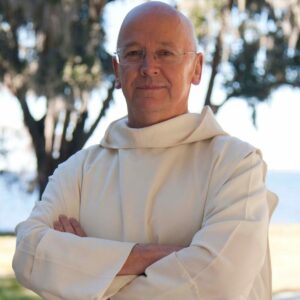
Fr Laurence Freeman OSB will run a retreat aimed at beginners and less experienced meditators. It will run from 03-08 February 2026. It will explore universal insights into meditation while also reconnecting with the Christian contemplative tradition – click here for further information or to register.
All meditators from Norther Europe, including Ireland, are invited to attend a retreat led by Fr Laurence from 17-22 February 2026 at Bonnevaux. He will address the theme of meditation as a never-ending journey, as a process of continual arriving. Click here to find out more.

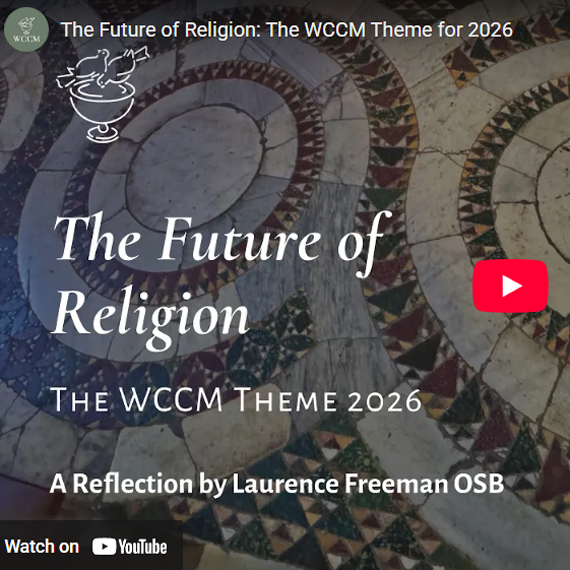
Not everyone has the ability to travel to Bonnevaux but the good news is that WCCM also offers a series of talks online. The theme for 2026 is ‘The Future of Religion’ and asks ‘How can spirituality evolve to meet today’s challenges’. The theme will be addressed over nine talks spread over the year, delivered by eight renowned speakers, seven male and one female, addressing the following:
10 February 2026 (Laurence Freeman) The Future of Religion 24 March 2026 (Tim Shriver) Back to Basics: Exploring the Point of Nothingnes 19 May 2026 (Elliot R Wolfmann) Encountering Nothing in Everything That Is 16 June 2026 (Sheikh Kabir Helminski) The Future of Religion 21 July 2026 (Mathieu Ricard) Emphasizing Compassion in Times of Uncertainty 01 Sept 2026 (Rowan Williams) From Ideology to Practice: Religious Integrity as “Doing the Truth” 06 Oct 2026 (Ilia Delio) From Axial Religion to Second Axial Religion 10 November 2026 (Rupert Sheldrake) Direct Experience and the Importance of Spiritual Practices 15 December 2026 (Laurence Freeman) Panel Discussion on the Theme
ONLINE TALKS 2026