


The John Main Seminar has been an annual event since 1984. It was established to honour John Main’s memory and develop the influence of his teaching in new fields and dialogue with the modern world. This year’s seminar will take place in Ireland, in Balally Parish, Dublin from 06-09 November 2025. The theme of this year’s event is: INTEGRAL CHRISTIANITY: The Vision of Celtic Christianity for the Crisis of the 21st Century.
Celtic Christianity was one of the most vibrant expressions of the Christ-event in history. It developed its own distinct forms of worship and achieved a striking mystical relationship with its pre-Christian roots, especially in the experience of God in Nature and in art. It was monastic in character and organisation and challenged the more centralised forms of Roman Christianity which eventually – or so it seemed – absorbed it. But the spirit of a Celtic style of Christian living is by no means extinct. This Seminar will avoid historical romanticism but will explore the reappearance of Celtic Christian wisdom today at a critical moment for human evolution. We will do this through spirituality, poetry, art, the Celtic sense of the sacred in Nature, pilgrimage, monasticism – and meditation.
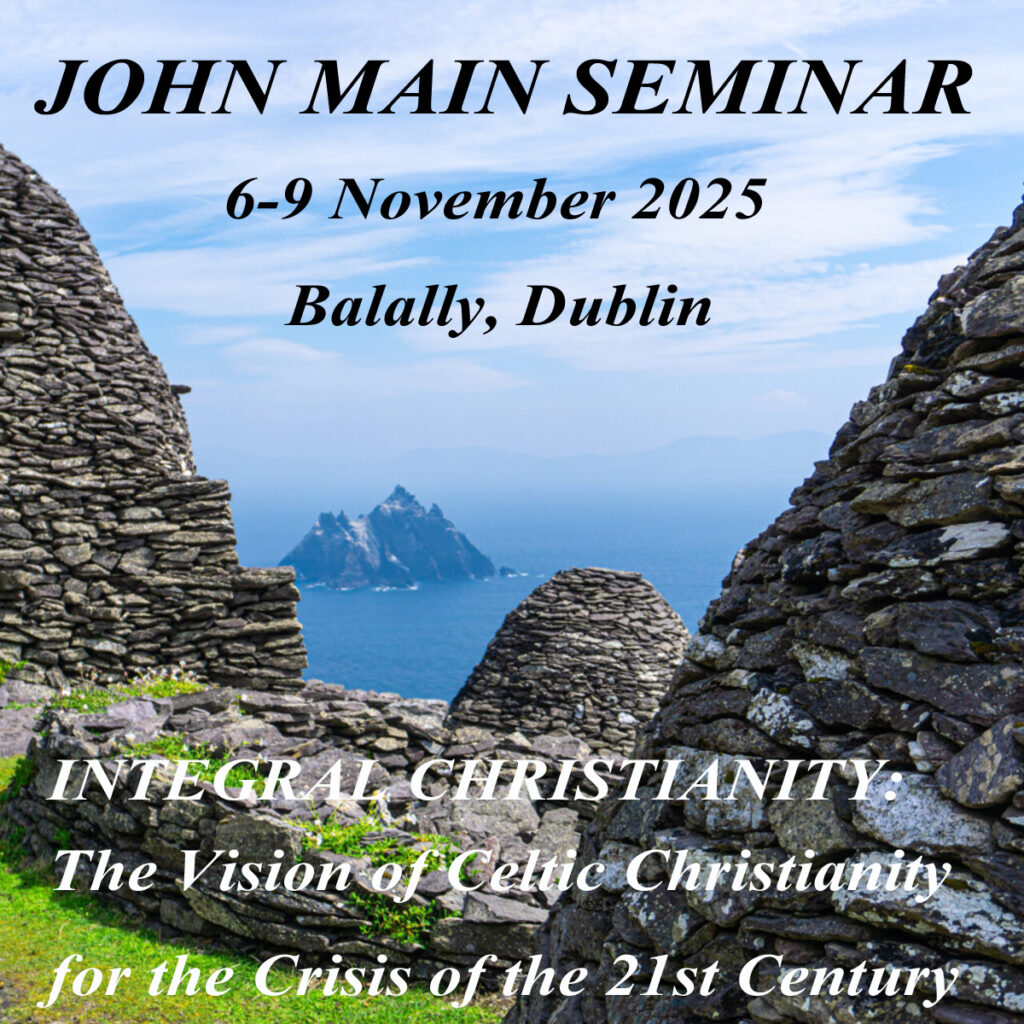
It is a gift and an incredible opportunity to have the seminar in our own country and you are invited to attend in person. However, it will also be possible to participate online. The sessions will be live streamed, and recordings will be made available a few hours after each transmission for those unable to join live. To find out more about the program, the speakers and the timing – or to register for the event – click here or on the image above.
For directions to the venue by car or by LUAS light rail transit, click here. Please note that Thursday will be a fast day, with a monastic lunch provided.
The Irish community of meditators includes men and women from all walks of life who come together to share and express a desire for deeper meaning and service in our lives through meditating together. In addition to the ideal of meditating twice each day at home, they meet together to meditate in small groups on a weekly basis, in homes, parishes, offices, hospitals, prisons, schools and colleges, in a spirit of openness and sharing with all. You can find a group near you by clicking here.
Some meditators choose to follow the Oblate Path, making a sacred commitment to a contemporary contemplative way of living informed by the Benedictine monastic tradition. The wisdom of the Rule of St Benedict helps meditators shape a lifestyle that grows from and supports daily practice and the integration of all aspects of one’s life, family, work, friends, social responsibility. Becoming an oblate can be a way of deepening and stabilizing the process of personal spiritual flourishing.
The WCCM Oblate community in Ireland is led by Dr Stefan Reynolds. There is a monthly Online Meeting for Irish Oblates and Friends and if you would like to know more – or to join that monthly gathering – you can contact Stefan via stefandreynolds@gmail.com – click here for a booklet about the Oblate Path. Four members of the Irish community will be received as WCCM Oblates during the 10 a.m. Mass on Sunday morning, 09 November, the final day of the John Main Seminar. The ceremony will take place in the Church of the Ascencion of the Lord, Balally, Dublin.
BENEDICT by Malcolm Guite
You sought to start a simple school of prayer,
A modest, gentle, moderate attempt,
With nothing made too harsh or hard to bear,
No treating or retreating with contempt,
A little rule, a small obedience
That sets aside, and tills the chosen ground,
Fruitful humility, chosen innocence,
A binding by which freedom might be found
You call us all to live, and see good days,
Centre in Christ and enter in his peace,
To seek his Way amidst our many ways,
Find blessedness in blessing, peace in praise,
To clear and keep for Love a sacred space
That we might be beginners in God’s grace.
Reflection by Noel Keating: As we approach the John Main Seminar 2025 it is appropriate that we reflect on the spirit of St Benedict, the founder on modern monasticism and the order of monks to which WCCM is affiliated. St Benedict’s Rule articulates his vision of the monastic family as a community of mutual love and mutual obedience or sensitivity. The World Community for Christian Community is an international monastic community without walls, a Christian community in which meditators are concerned with the Other – and the other – by forgetting himself or herself.
John Main tells us that the strength of monastic community lies in the fact that we come to know ourselves in the perfecting relationships that we establish with others and that ‘each one of these relationships is itself a sacrament of our fundamental relationship with Christ and his Father in the Holy Spirit.’ The call of a committed meditator is ‘to explore this fundamental relationship to the full – at whatever cost to ourselves.’ Main goes on to remind us that ‘the strength of Christian community’ lies in the apparent paradox ‘that when everyone is for the other, everyone becomes himself or herself.’ The community lives out Christ’s insight that the ‘person who would find his life must lose it’. In other words, the real self is found in community – in commitment to the other – and not in the crowd.
The opening line of the poem recalls that St Benedict set out to start a simple school of prayer. Yet, as John Main reminds us, while his Rule ‘does not give an ordered exposition of his theory of prayer … he does unequivocally instruct his monks to pray often and to this end he sets apart a special room for prayer in the monastery which is a place of silence.’ Wherever weekly meditation groups meet is such a space. The purpose in meditating together is to help one another to grow and deepen our understanding of St Benedict’s basic premise: ‘In order to teach us to love the God whom we cannot see he asks us to begin by loving our neighbour whom we can see.’ For Benedict, ‘prayer was to be short rather than long, frequent, simple and silent.’
Our commitment to our twice-daily meditation supports us, as the poem says, to ‘centre in Christ and enter in his peace’; it helps us ‘to clear and keep for Love a sacred space, that we might be beginners in God’s grace.’

