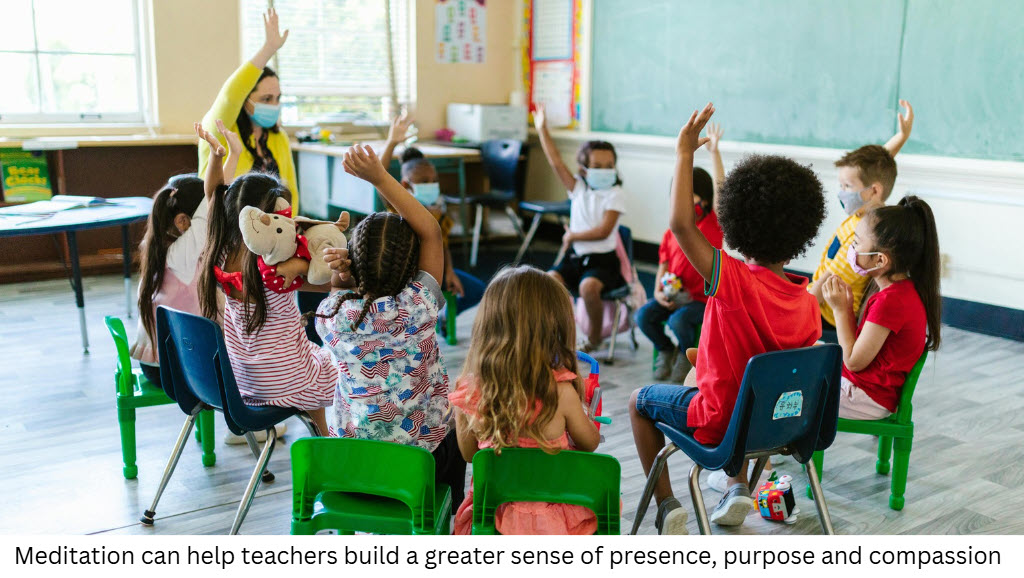
World Children’s Day is celebrated on Wednesday, 20 November this year. It is UNICEF’s annual day of action for children, by children, marking the adoption of the United Nations Convention on the Rights of the Child. Adopted in 1989.
Why not make a point of acknowledging the day by meditating with your class , even if it is not one of the regular days for meditation in your school? Use it as an occasion to meditate for peace in the world so that children everywhere might enjoy the rights we enjoy in Ireland.
Meditation contributes to the wellbeing of children in so many ways. In my doctoral research, the children told me that it helps them to let go of all the drama in their lives and helps them to be themselves and to find the goodness inside. Please help us to spread the word! Talk to other teachers about how the children in your class benefit from their regular meditation in school. And, please do encourage children to meditate at home and to teach their parents as well!

The video on the left explores children’s rights in a child-friendly way. It is important that children understand that, like all human beings, children have rights and – depending on their age and circumstances – to know also that these rights are not fully respected everywhere.
Unicef has a discussion paper which presents the findings of a literature review in relation to child rights education with very young children (aged 3 – 6 years), and the outcomes of some informal research undertaken with practitioners working on this topic in seven countries. You can read the discussion paper here.
It is important to remind children that while meditation has some very useful, practical benefits – e.g. it helps children let go of all the drama – it is also a form of silent prayer which gives rise to deep fruits.
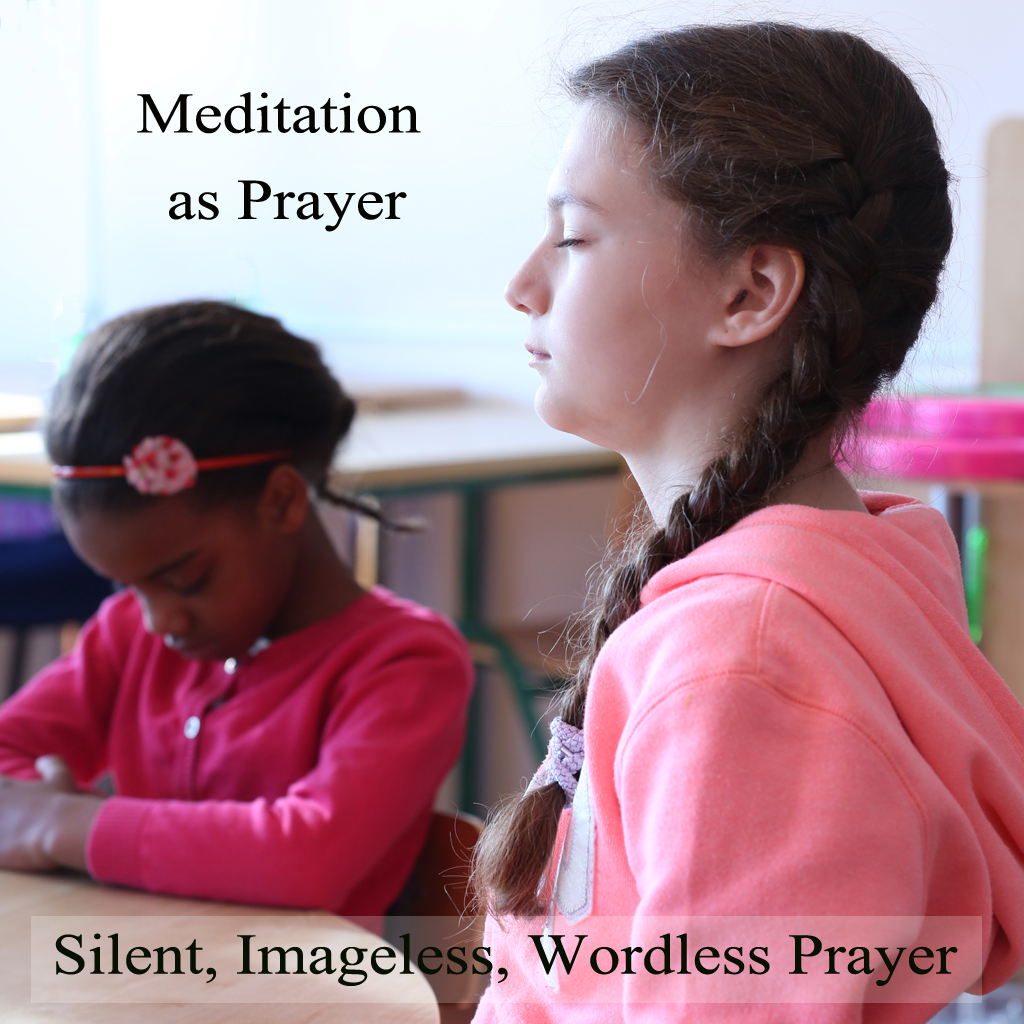
Prayer is understood to be the raising of the mind and the heart to God. While mental prayer, saying our prayers, asking God to help us solve the challenges we face in the world today, is widely promoted within the church, there is less emphasis on contemplative prayer, on raising the heart to God. In the Christian tradition, meditation is a form of silent, imageless wordless prayer. Simply being with God, with Jesus. Not saying anything but simply being. Not doing anything, just being ourselves. In meditation we let go of all thought and all words and images.
Because we know how easily thoughts arise in the brin, we give our minds something to focus its attention on; in meditation we bring our attention off ourselves and on to our word Ma..ra..na..tha. And we open our hearts to God. Alex, a 12-year old Canadian girl, told me that when she hears the bells ring at the start of meditation, she imagines God is ringing her doorbell and she opens her heart to let Him in.
Have you tried the two short verses we wrote – one for before and the other for after meditation?
Many of you are using our regular short video meditation timers, but did you know Noel also has a set of timers that include the opening and closing songs – they are here.
Perhaps you know of a secondary school teacher who might be interested in a program designed for teaching meditation to teens. If so, let them know about this page!
Dear Human by Courtney Walsh
Dear Human: You’ve got it all wrong.
You didn’t come here to master unconditional love.
That is where you came from and where you’ll return.
You came here to learn personal love.
Universal love. Messy love. Sweaty love.
Crazy love. Broken love. Whole love.
Infused with divinity. Lived through the grace of stumbling.
Demonstrated through the beauty of…messing up. Often.
You didn’t come here to be perfect. You already are.
You came here to be gorgeously human. Flawed and fabulous.
And then to rise again into remembering.
But unconditional love? Stop telling that story.
Love, in truth, doesn’t need ANY other adjectives.
It doesn’t require modifiers
It doesn’t require the condition of perfection.
It only asks that you show up. And do your best.
That you stay present and feel fully.
That you shine and fly and laugh and cry
and hurt and heal and fall and get back up
and play and work and live and die as YOU.
It’s enough. It’s plenty.
from Dear Human: A Manifesto of Love, Invitation and Invocation to Humanity, (Findhorn Press, 2016).
Reflection by Noel Keating:
Speaking to Oprah Winfrey in 2015, in response to her question, ‘What message do you most want to convey to viewers?’, Richard Rohr responded ‘That a relationship with God is not about worthiness. Instead, it’s about God’s radical grace and unconditional love for us all. “God doesn’t love you because you’re good. God loves you because God is good.’ Isn’t this the core of the message from our poem, which reads as an imagined letter from God to each one of us: You didn’t come here to master unconditional love. That is where you came from and where you’ll return. I love the understanding that last phrase contains – that we came from Love and will find ourselves once again embraced in the arms of Love when we leave this earthly realm. When we begin to look inwards and deepen our spiritual awareness we often think of ourselves, as Teilhard de Chardin observed, as human beings on a spiritual journey when, in fact, we are spiritual beings on a human journey.
The poet goes on to describe our core universal purpose in this realm as follows: You came here to learn personal love and goes on to describe the process as messy, sweaty, crazy, and broken … lived through the grace of stumbling. The poet reminds us too that Love, in truth, doesn’t need ANY adjectives. It is sufficient in itself and it doesn’t require modifiers of any kind. It only asks that you show up. And do your best. That you stay present and feel fully. Richard Rohr reminds us that religion sometimes can be one ‘of the safest places to hide from God’, if we find ourselves attending only to doctrine and dogma, rules and rituals and becoming caught up in who’s right and who’s wrong and in striving to become perfect! As the poet reminds us, growing in love is demonstrated through the beauty of…messing up. Often. I am struck by how the adjectives the poet uses to describe the process of learning to love personally – messy, sweaty, crazy, and broken – might also describe our experience of meditation!
Our daily practice is not expected to be perfect either – it may be very helpful to understand it as a form of personal spiritual experience through the grace of stumbling. And what she says about Love applies equally to our daily practice: It only asks that you show up. And do your best. That you stay present and feel fully. By feel fully in this sense I mean apprehending who you are at the deepest level of our being, beneath the noise of all your doing.
When we first begin to meditate and realise how incredibly difficult it is, we can be so easily tempted to abandon the project thinking ‘I’m not good at this! I can’t do this!’ We find it so hard to tolerate having to face the sense of inadequacy that we discover in ourselves and we convince ourselves we would be better off ‘doing something’!
But if we persist in our daily contemplative practice we discover that our faithfulness awakens or renews and deepens our awareness that we are sitting in the presence of God all the time and that She is always about and within. We discover that our practice liberates us from the tyranny of allowing distraction the power to name who we are. As we begin to apprehend our true-self, as we sit with that awareness; we learn to lean into it again and again; we learn to hold fast to this Love that sustains us in the midst of our messy, daily lives. As James Finley observes: ‘It is in this way, little by little, that we come to understand the unsubstantiality of everything but Love. Love and Love alone has the authority to name who we are.’