

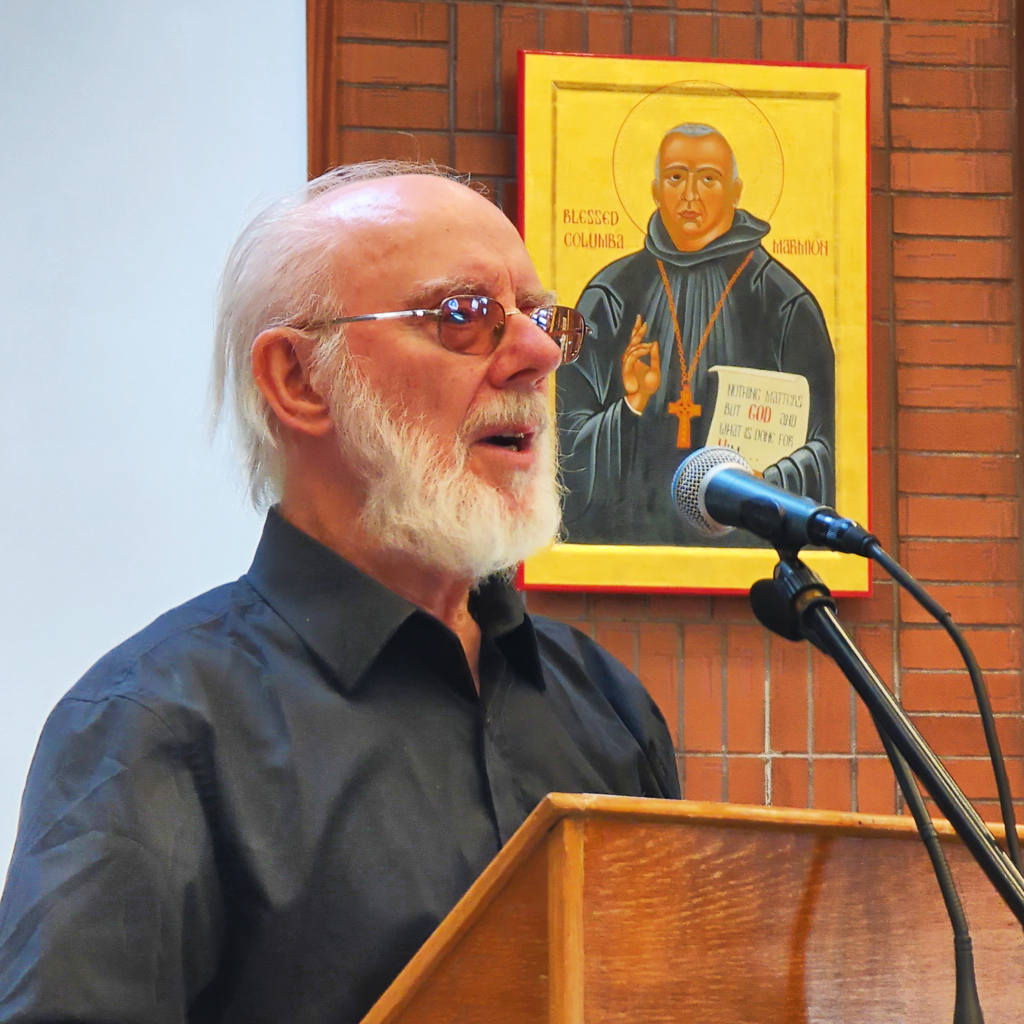
Fr Donagh O’Shea will lead a morning of meditation and reflection on Saturday, 09 November 2024 from 10:00 a.m to 1:00 p.m. at Balally Parish Centre (Eircode D16 E032). Donagh will speak to the theme ‘Meditation: Falling Awake‘.
There will be two sessions: from 10 a.m. to 11:15 a.m. and 11:45 to 1:00 p.m. with a half-hour break for refreshments in between. There is no need to book in advance – just turn up on the day. There is no charge but donations will be greatly appreciated on the day (€20 suggested).
There will be no lunch provided but those who wish to do so may bring a sandwich for lunch and tea/coffee will be available in the parish centre afterwards. Donagh’s latest book is entitled ‘A Holy Mess: – Making the Most of our Misfortunes.’
Balally Parish, near Dundrum in Dublin, strives to be a contemplative parish and a place of welcome for all who are pilgrims on the contemplative path. The parish regularly organises talks and events that are deeply contemplative in nature.
The parish offers daily morning and evening prayer in the Icon Chapel in the Parish Centre (D16 E032) every Monday, Wednesday, Friday and Sunday morning at 9:15 a.m. and every Tuesday, Thursday and Saturday at 10 a.m. In addition, there is a Contemplative Mass in the Lane Room at 7p.m. on Tuesday evenings.
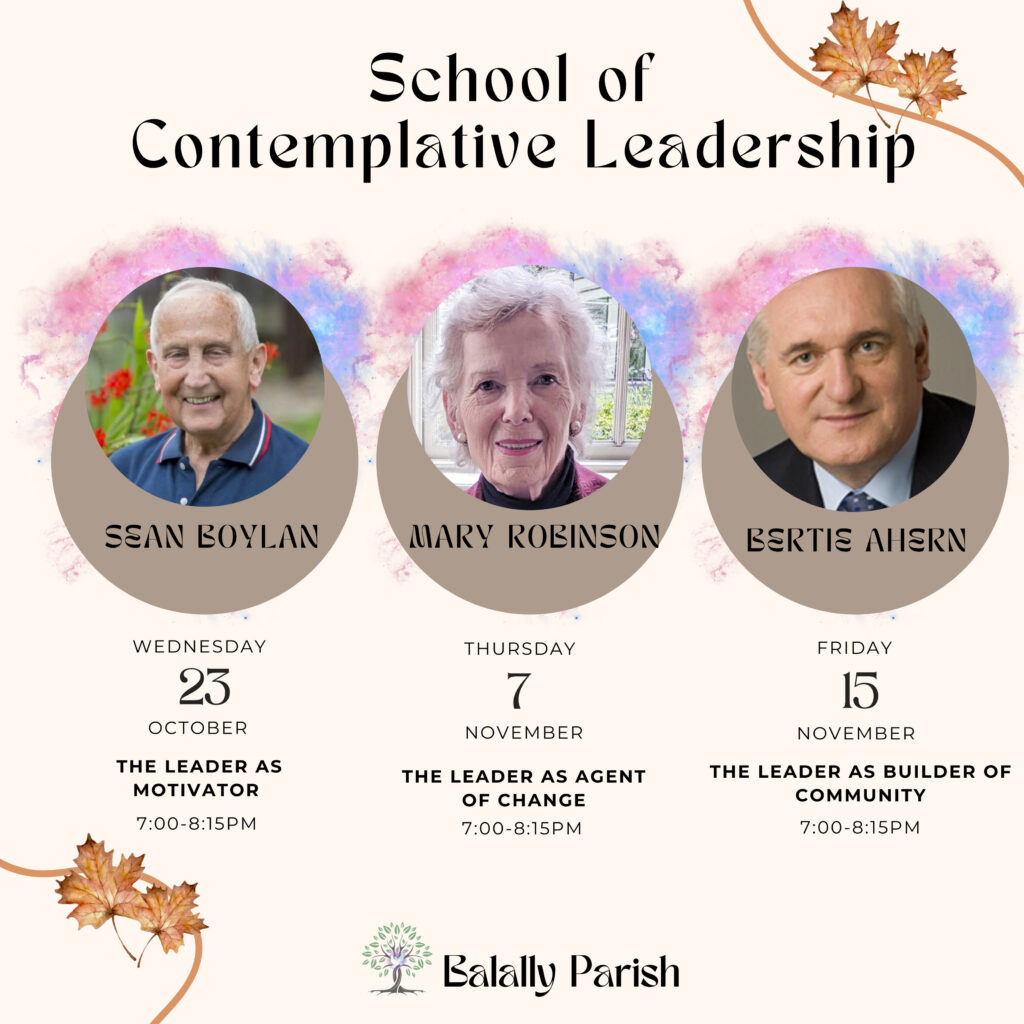
Last year, the parish started a ‘School of Contemplative Leadership‘ whereby experienced leaders in various fields are invited to address different aspects of contemplative leadership. The first talk in the series took place in May 2024 when Herman von Rompuy, former Prime Minister of Belgium and former President of the European Council, addressed the question of ‘Meditation Supporting Democracy‘.
The next talk in the series will take place on Wednesday, 23 October from 7-8:15 p.m. in Balally. The speaker will be Sean Boylan, former manager of the Meath Senior GAA football team. His theme will be ‘The Leader as Motivator.’
This will be followed by two further talks in November, each running from 7 p.m. to 8:15 p.m.. Former President Mary Robinson will address the theme ‘The Leader as an Agent of Change‘ on Thursday, 07 November and Bertie Ahern will speak on Friday, 15 November on the theme ‘The Leader as Builder of Community‘.
Prayer by Marie Howe
Every day I want to speak with you. And every day something more important
calls for my attention—the drugstore, the beauty products, the luggage
I need to buy for the trip.
Even now I can hardly sit here
among the falling piles of paper and clothing, the garbage trucks outside
already screeching and banging.
The mystics say you are as close as my own breath.
Why do I flee from you?
My days and nights pour through me like complaints
and become a story I forgot to tell.
Help me. Even as I write these words I am planning
to rise from the chair as soon as I finish this sentence.
Read the poem a second time and ask yourself: ‘How do these words sit with me? What in this poem resonates with my own experience, with my own deepest desire?‘
Reflection by Noel Keating: Our poem describes the experience of so many who have felt that deep call to set aside all doing and simply be in God’s presence. The poem begins with that simple line ‘Every day I want to speak with you.’ That line strikes me very deeply for two reasons. Firstly, because it captures my deep desire at the start of each day to be in communion with God. My first thought each day is a prayer of thanks for a good night’s sleep and for the gift of another day. And a heart-felt desire to be attentive to what is being asked of me throughout the day and to be responsive and authentic in my actions. I like to ask, after Hafiz, what mischief are we going to get up to today.
The opening line – Every day I want to speak with you – speaks to me in another way also because of how we been raised to think of prayer as a discursive activity – as speaking with God. We have been taught to say our prayers, to recite the Our Father or the Hail Mary and at church services to recite the creed, and prayers of petition and thanks. But contemplative prayer is a prayer of the heart, not the mind. John Main captured this understanding when he said that meditation moves the centre of gravity of our consciousness from the head to the heart. Just as meditation in our tradition is not a form of mental prayer but a prayer of the heart, the fruit of meditation is not rational knowledge but knowledge of the heart.
As John Main expressed it ‘The “heart” is that focal point in our being where we can simply be in the Mystery – be in the mystery – without trying to explain or dissect it. A mystery analysed becomes merely another problem. [Instead] It must be apprehended whole and entire.’ Our poem goes on to describe how, despite this deep desire to spend time with God, every day something more important calls for my attention. And she itemises the tasks she needs to get done that regularly draw her away from her intention to pray. And even when she wins the battle and does sit down to pray, she finds it so hard to do so among the falling piles of paper and clothing, the garbage trucks outside already screeching and banging and, instead of praying, she chooses to write this poem and becomes acutely aware that even as I write these words I am planning to rise from the chair as soon as I finish this sentence.
James Finley, who writes beautifully about the practice of contemplation, makes the same point when he observes that we spend so much of our lives trapped on the outer circumference of the inner richness of our lives. While meditation is intended to be a silent, wordless, imageless form of prayer … despite this intention, this deep desire, to be still in body and mind, when we sit down to meditate we find that we are still habitually established in our internalized thoughts about God, our internalized reflections upon God. In meditation, the aim is not to reject any of that but to let go of all doing for the period of meditation and simply be. In meditation we aim to allow our ‘typical thinking self in our day-by-day consciousness to fall into the background so that a more contemplative interior beholding consciousness might come into the foreground.’ We bring our attention to our sacred word, to our mantra, so that we can ‘ move forward into our love for God beyond all our thoughts – even thoughts about God.’ In meditation, all we can do is let go. Nothing else makes sense when we are alone with God – there’s nothing worth holding on to, because there is nothing else we need. Our desire to be in communion with God is sufficient.
This truth is captured imaginatively and joyfully in another poem, A Horse in the Meadow, from Mesiter Eckhart’s Book of Secrets:
Have you seen how a horse,
On a summer’s afternoon
In a wide green meadow
Gallops and dances and springs
About in the sun and wind?
This is just how God delights
In pouring God’s self into you.
Just like this.
Meditation, then, draws us into a joyful union, a communion, beyond thought, beyond words. Repeating our mantra is a strategy, a discipline to help us both to obey the promptings of our heart. Our daily practice discloses to our heart an ever deepening sense of our participation in the mystery in which we live and move and have our being and prompts us to live our lives from our true-centre, aware of who we are in the depths of our being, intimately connected to God, to one another and to all of creation.
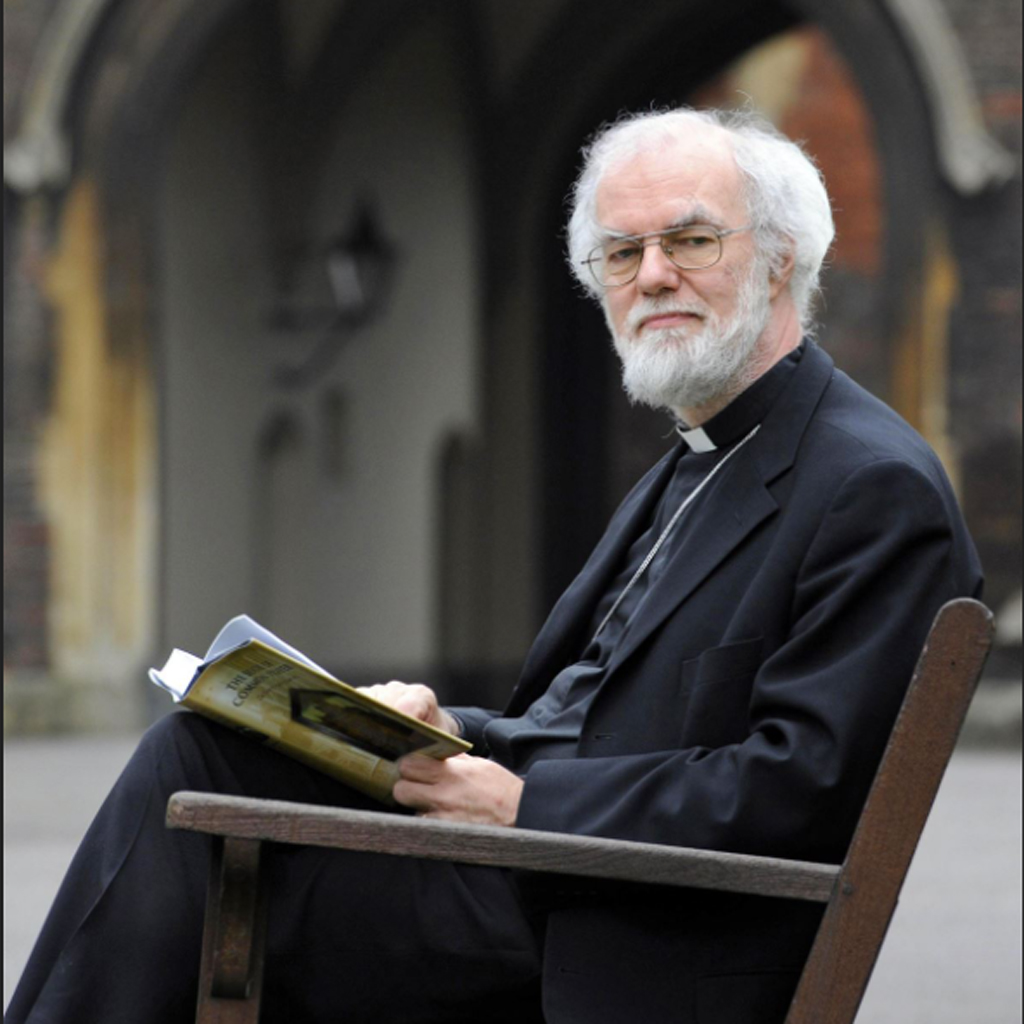
We had a wonderful weekend on Sat 28 and Sunday 29 September with Rowan Williams on the occasion of the second annual Dermot Lane Seminar in Balally, Dublin.
In his first talk Rowan reminded us that the Holy Spirit was present both at the conception and the baptism of Jesus and was released into the world after Christ’s passion. It has already been given to us and we need to engage in practices that allow it to well-up in us and through us into the world. But, he reminded us, that to be graced by the Holy Spirit is not necessarily a joyful, powerful feeling. Truth has its costs, but we are given the capacity to be anchored and grounded in God so that we can cope with the challenges it brings. Our calling is to bring one another alive in Christ, to enable Christ to be born in each one of us; and, in the modern world, we need to speak the language of humanity rather than merely in the ‘tribal’ language of a particular tradition. He reminded us too that the Holy Spirit may not always guide us to what we ourselves might regard as the next obvious step but will draw us to where we are really needed, and we must put our trust in that.
Rowan’s second talk was on the journey inwards, the journey of contemplation, which is always a journey to where Christ is. Contemplation is about realising the truth of Christ in us and, as such, is a protest against idolatry. In contemplation, we surrender our attachments to so many things that limit our freedom; he described contemplation not as a place of isolation but as a place of ‘unstuckness’ which allows for joy to find expression through us. Through our daily practice of contemplation we grow in self-knowledge, which is really ‘knowledge of where I belong‘.
In his final talk on Sunday afternoon, Rowan reminded us that life in the Holy Spirit is a life of belonging together, where we encounter the other as belonging too. We come to appreciate that the other always has something I need, always has life to give me. We truly encounter Christ in one another. Our task is to help one another to become givers of goodness. Contemplation helps us to keep looking and finding new ways to release the energy and gifts of the Holy Spirit in one another.
The three talks were recorded and are available for purchase and download for a total of €10 from Éist by clicking here and paying online. They are also available on CD and USB from paul.daly@eist.ie or by phoning Paul on 087 2789390
John Main regarded the creation of community as a deep fruit of contemplative practice. The Cork and Dublin regions of Christian Meditation Ireland hold two meet-ups each year for groups in their regions and we very much encourage other regions to arrange similar events, if not regularly at least occasionally. If you do so, please send us in a brief account of your day. We are delighted to give an account of a day held in September in Solas Bhride in Kildare town.
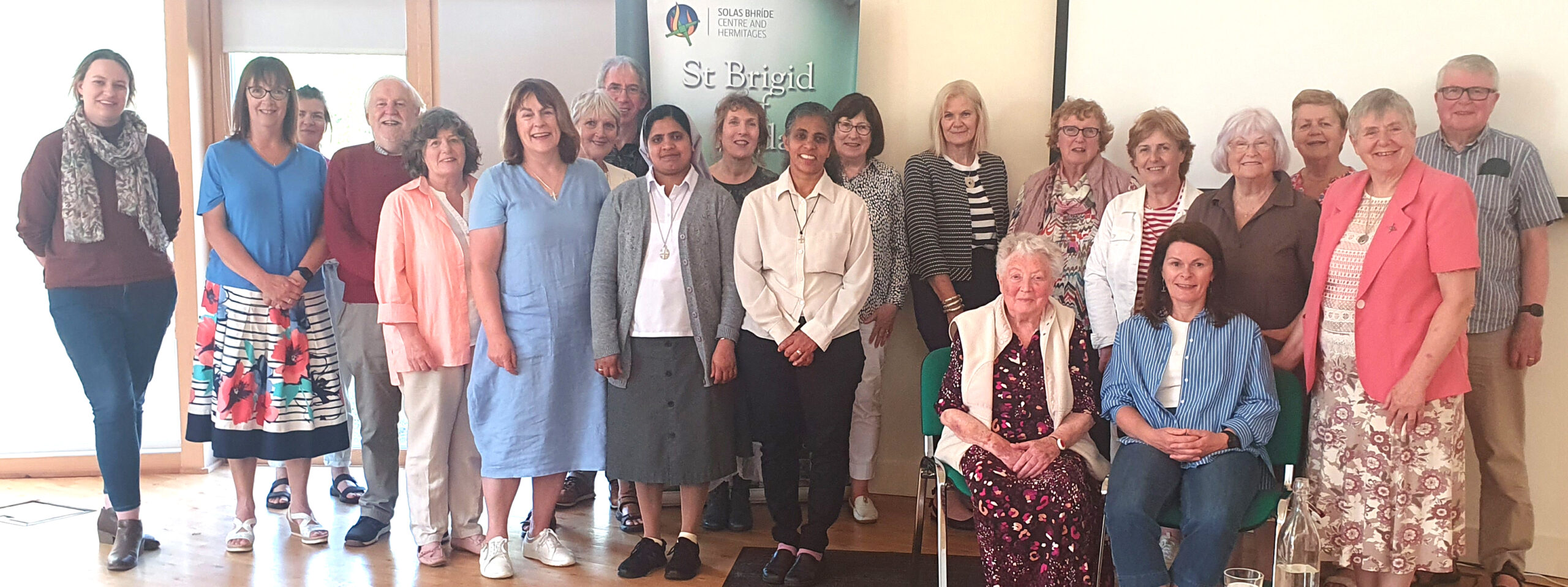
The day was attended by members of local groups, joined by some friends from Limerick. The theme for the day was ‘The Season of Creation _To hope and Act with Creation.’ Sr Phil O Shea, Solas Bhride Team member and Brenda Kindregan, a Brigidine Associate, facilitated the day of reflection and meditation. A deep sense of connectedness emerged from the outset as participants identified shared connections. The work of Thomas Berry was referenced throughout the day as a reminder of our connection to the entire universe: ‘The human is neither an addendum nor an intrusion into the universe. We are quintessentially integral with the universe.’ As the current environmental crisis can be as seen as reflecting a spiritual crisis the words of Thomas Berry can resource us: ‘The present time is not a time for desperation but for helpful activity.’
The day provided an opportunity to reflect on what supports each of us to create and sustain meaningful and hopeful connections to creation in all its forms; as Kenneth White expressed it: ‘seeing the loveliness everywhere.’ Time was spent experiencing the importance of each of us in our own uniqueness taking time to slow down, to pause ‘to rediscover the earth‘, ‘reword the world‘ and ‘allow this new relationship to reshape how we speak and act…. (so that we can) … journey towards …a new way of being.’ Creation as we experience it today has taken 13.7 billion years to reach this stage. It will continue to evolve and every choice we make can influence that process. If that feels a little overwhelming, the words of Karine Polwart invited us to see it in a more manageable way: ‘The path that winds before us is not for us to know, one step and then another is the only place we have to go.’
As the day came to a close there was certainly a feeling of hope that each of us is privileged to be part of this amazing universe and interested in acting in partnership with it. May our daily practice of meditation make us ever more keenly aware of the mystery in which we live and move and have our being and help us to appreciate that we inter-are with one another and all of creation and help us to hope and act in cooperation with creation. [Thanks to Rosario McCreery and Lucy Higgins for this account and for organising the day!]
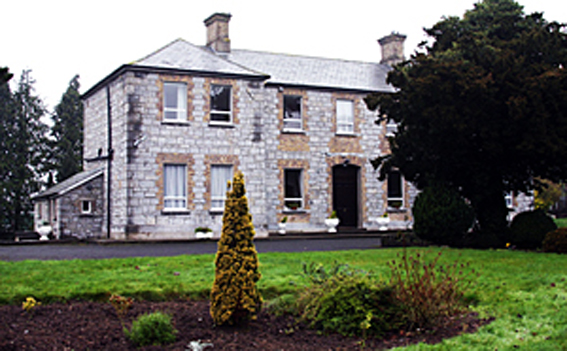
Ger McDonnell, who leads a meditation group in Rush, Co Dublin will facilitate a programme on ‘Meditation & Growth over three Saturdays in November and December. The venue will be Galilee House of Studies, Galilee House, Cardington, Athy, Co. Kildare, R14 HV57. The dates are Sat 16 November, Sat 30 November and Sat 14 December 2024 from 10 a.m. to 4:30 on each occasion. Ger adds that soup, coffee and tea will be provided and the kitchen facilities may be utilised to make your own lunch. The venue is relatively small with a dedicated Meditation Room. There is no charge but participants are asked to consider making a small donation to Cuan Mhuire. Should you wish to participate, contact Ger by text on: 087 6159403, He will call you back and provide any information you might need regarding the sessions.
Some established meditators within WCCM feel attracted to the wisdom and the rule of St Benedict and make a commitment as Oblates of WCCM. On the first Friday of each month, there is an online gathering of Irish Oblates and Friends. The session includes readings from the Psalms and John Main, a 25-minute meditation and Lectio Divina.
All who would like to experience this 80 minute gathering of contemplative prayer are very welcome to join without obligation. If you would like to know more, contact Stefan Reynolds via stefandreynolds@gmail.com or by phone on 086 4677077.

