

Laurence Freeman writes: ‘When the doctor found a growth in my bladder his first, reassuring words were ‘we can fix it.’ The operation has gone well, we await results and the body is restoring itself wondrously.’ He will receive immunotherapy once weekly for the next six weeks. Laurence greatly appreciates the expressions of concern and support that he received from so many across the WCCM community.
Fr Laurence still expects to make a weekend visit to the Balally Parish, Cedar Road, Dublin D16 E032, in early December to open the John Main Meditation Room and to give two talks on Saturday morning, 02 December. Each talk will be followed by Q&A and time for meditation. The event will start at 10 a.m. and finish at 13:30, with a refreshment break from 11:30 to 12 noon.
Please book through Eventbrite – that helps us to ensure that we have sufficient seating and refreshments in place. To book your place – and consider making a donation to offset our costs – just click on the image to the right. Thank you! If you are unable to book throuigh Eventbrite, you are free to turn up on the day (and make a donation if you wish!)


Laurence has found one benefit of his experience of illness and community is the grace of a sharper oneness with all those who suffer. The news and images of human pain created by inhumanity in Gaza and Ukraine understandably outrage, sicken and depress us.
But, like the illness of one body when it is undergone in community, the ordeal of these two places – and so many others – can illuminate the One Body we belong too. That becomes the source of hope and of our hunger and thirst for justice and peace.
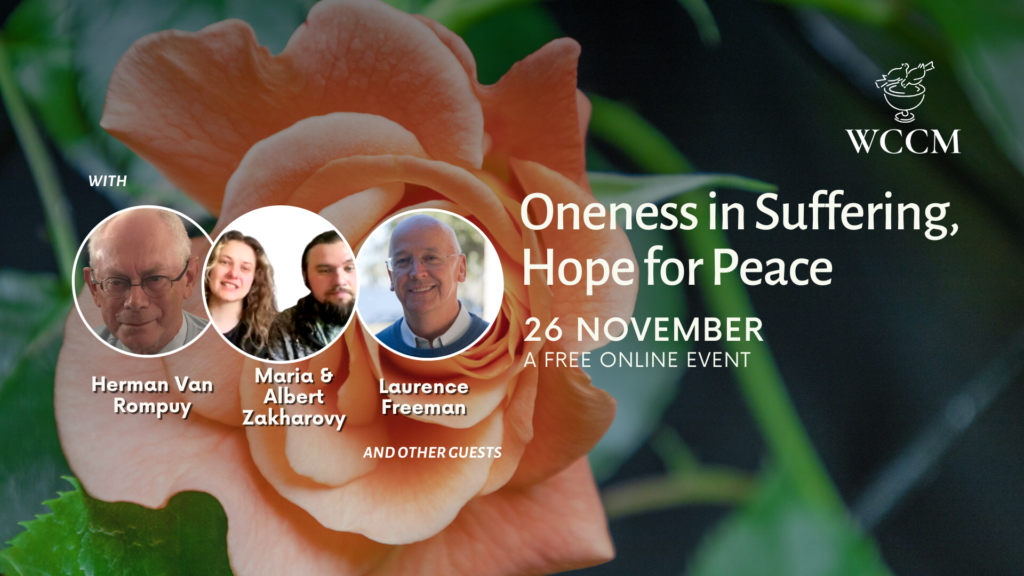
Because of the mystery of oneness revealed in suffering, Laurence invites all who can do so to join him online on Sunday 26 November, from 2-4 p.m. Irish time. The aim is to convene a community of love in solidarity with those desperately struggling in Ukraine and Gaza and other parts of the world and also with those in extreme loneliness on the streets of our cities, in hospitals and prisons.
To find out more, click in the image to the right. Then scroll to the end of that page to register and you will receive the Zoom link by email closer to the time.
Speakers will include Fr Laurence, Maria and Albert Zakharovy (National Coordinators for Ukraine & Russia) and Herman van Rompuy.
This is a free event and the hope is that meditators from all over the world will join in on Sunday, 26 November from 2-4 p.m. Irish time.
We had a very successful Regional Coordinators’ meeting online on Saturday, 11 November 2023. We are very appreciative of those who give up of their time to help animate our meditation community at regional level.
Sylvia Thompson, from Tralee, gave a very encouraging and affirming talk on the value of our work in promoting the practice of meditation. She began by exploring her introduction to contemplation as a young person; she grew up beside a contemplative order and was offered the opportunity for contemplative prayer in her local secondary school, so it was, in a way, always part of her life. As a result she always felt drawn to the practice. She recalled that her first visit to a meditation group involved a 25-min meditation without any introduction or instruction; challenging as that was, she kept returning.
This was a core theme of her talk, the importance of returning – both to one’s daily practice and weekly group but also returning to stillness and silence during each meditation session every time you realise you have become distracted by thought, emotion or feeling – gently returning to your word and to your intention to be still and silent in God’s presence.
Sylvia mentioned how helpful it was when, many years ago, CMI arranged some simple training for group leaders about introducing a session, especially when newcomers arrive – to make them welcome and to offer a simple introduction to the practice. She recalled the usefulness of ‘Silence and Stillness in Every Season’, Paul Harris’ collection of John Main readings. She noted that however one of his talks began and developed, the core message was always that we are intimately loved by God for who we are and meditation is ultimately about resting in that heart-felt knowing. She has learned that taking a moment to come to stillness, before ringing the meditation bell, can be helpful – indeed, even before starting a walk in nature it can be really helpful to take a moment to bring oneself to stillness rather than start walking while the mind is busy elsewhere!
Sylvia noted that their group puts a simple notice in the parish newsletter, a few times each year, about their Monday meditation and they have a notice on a sandwich-board which they leave outside the Church before and during their meditation. Their Monday meditation at 5 p.m. is broadcast online over the parish webcam and anyone can join at that time each Monday (excluding Bank Holidays) by clicking here. She reminded us that the size of our group doesn’t matter – groups grow and shrink all the time. The important think is to be faithful, to keep returning.
In the course of her talk Sylvia mentioned she was part of an online book club inspired by the papal encyclicals Laudato Si and Laudato Deum – they are currently reading ‘Deep Incarnation’ by Denis Edwards and while it was a challenging read it helped to broaden her understanding of the Cosmic Christ. This is also a theme of Richard Rohr’s book ‘The Universal Christ.’
For those who are especially interested in ecology and climate change, the Laudato Si Research Institute at Oxford College have created an Open Access Laudato Si’ Integral Ecology Collection which gives free access to a wide range of related texts on the topic – click here to find out more.
This month we are delighted to welcome Mairead Burke who has joined the Board of Christian Meditation Ireland and has agreed to act as Regional Coordinator for the Dublin Region. Many thanks for your generosity!
Some established meditators within WCCM feel attracted to the wisdom and the rule of St Benedict and make a commitment as Oblates of WCCM. On the first Friday of each month, there is an online gathering of Irish Oblates and Friends and all who would like to experience this 80 minute gathering of contemplative prayer are welcome. If you would like to know more, contact Stefan Reynolds via stefandreynolds@gmail.com
I Want to Listen to Your Absence by Rosemerry W Trommer
I want to listen to your absence
the way I listen to the night—
the way the dark somehow
invites a deeper listening.
I want to hear, for instance,
the way silence fills in
where your voice has been,
or the way the room seems to know itself
by the pound of missing footsteps,
and in this way, I find you
where I cannot find you.
I am thinking of how the night opens up
between the calls of the owl
and how I listen in that interval
not only with my ears, but with my skin.
I want to listen for you with my lungs—
as if every breath is attentive
to the syllables of grief, of love.
I want my heart to angle in
to hear what the silence has to say.
I don’t want to hear what I most want to hear—
I want to hear what is really here.
I want to listen and learn from the listening.
I want to hear what is true.
I want to listen into your absence
and lean into it the way I lean into the night—
something so much larger than me,
something familiar and always new,
something so present, yet unable to be touched.
Something I am still learning to love.
from All the Honey (Samara Press, 2023)
Noel Keating Reflects: I suspect that this poem was written by Rosemerry following the death of her son. It speaks of a deep yearning for a different way of being in touch with that which seems to be missing but which she knows is nonetheless mysteriously present. Those who meditate will recognise that the poem relates to what the Christian tradition calls apophatic prayer – prayer without words or images, a silent, wordless, imageless form of prayer which can give rise to a very deep sense of communion with Reality which is the ground of all being.
Richard Rohr writes that ‘Apophatic prayer involves a mindful and relinquishing disposition in the process of communing with God. This contemplative method of praying does not use images, requests, intercessions, and rituals. It involves the quieting of one’s spirit and the settling into the essence of being, which allows one to be found in the presence of God.’
The poet wants to hear the way silence fills in where your voice has been and it is in this way that I find you where I cannot find you. She wants her heart to angle in to hear what the silence has to say. Isn’t that a fine description of what we seek to do in meditation. We lean in to the silence so that our heart can be in harmony, in communion, with Reality; we lean into something so much larger than us, something familiar and always new, something so present, yet unable to be touched. Something we are still learning to love.
But such learning is not about love as an intellectual concept – instead, is a heart-learning. Just as meditation in our tradition is not a form of mental prayer but a prayer of the heart, the fruit of meditation is not rational knowledge but knowledge of the heart. As John Main expressed it ‘The “heart” is that focal point in our being where we can simply be in the Mystery without trying to explain or dissect it. A mystery analysed becomes merely another problem. It must be apprehended whole and entire.’
Richard Rohr observes that our understanding of God comes mainly through an acquisition of knowledge that affirms what and who God is. This is the kataphatic way of knowing God – knowing God through words, images and concepts. But the apophatic tradition recognises that when we speak of God and things transcendent, all we can do is use metaphors and pointers, because no language is adequate to describe the ineffable.
To help us move beyond concepts that box us in, to disrupt our mental conditioning about God, John Main often used other names such as Divine with a capital D, Presence with a capital P, Love with a capital L, Reality with a capital R, Mystery with a capital M, and so on. Because meditation awakens the heart it invites us beyond limitations and known categories to ways that make room for what we don’t know and cannot comprehend about the Divine. It draws us deeper into the transcendent Mystery in which we live and move and have our being. As the poet discovered, apophatic prayer can lead us into to experience the Divine beyond what we know, into a state on Unknowing which resonates strongly with our deepest sense of self-identity.
Pointing toward this apophatic tradition of unknowing, the Franciscan theologian Bonaventure ended his classic text The Soul’s Journey into God as follows: If you wish to know how these things come about, ask [for] grace, not instruction, desire not understanding, the groaning of prayer not diligent reading, the Spouse not the teacher, God not man, darkness not clarity, not light but the fire that totally inflames and carries us into God.’
Meditation helps us to restore a balance in our lives between the two ways of knowing by opening our hearts to God. As Alex, a twelve-year-old Canadian girl, once told her teacher ‘When I hear the chimes at the start of meditation, I imagine it is God ringing my doorbell and I open my heart to let Him in.’ We seek to simply be in Her presence, letting aside all forms of doing. We simply repeat our mantra in a way that is diligently effortless.
Our very active Cork region will be holding their next event on Saturday, 18 November in the Missionaries of the Sacred Heart Hall on Western Road, Cork, T12 TN80 from 10 a.m. until 1 p.m. The event will comprise two talks interspersed with periods of meditation and an opportunity for Q&A. It will be followed by Mass at 1 pm for those who wish to stay for it. Participants bring their own lunch and the organisers will provide tea, coffee and biscuits. A donation of €10 is suggested.
In honour of the 55th anniversary of the death of Thomas Merton, theologian Fr Michael Downey will give talks on the legacy of Thomas Merton on Mon 11, Tues 12 and Wed 13 December 2023 from 7 – 8 p.m. each evening. No need to book for either event but donations will be greatly appreciated.
Why not add a note in your parish newsletter advertising your weekly meditation group – two or three times each year? For example: ‘Our Christian Meditation Prayer Group meets every (name the day) at (name the time) for 30-40 minutes of silent prayer in (name the venue, with Eircode if known)

